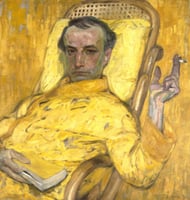
Analisi esperta di Danse Macabre di Frantisek Kupka
Stile: Expressionism, Symbolism · Genere: symbolic painting
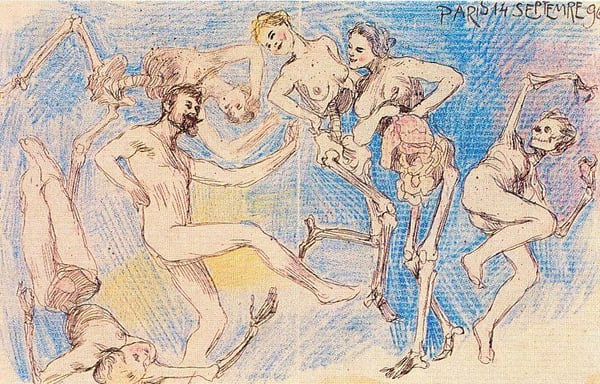
An expert analysis of Frantisek Kupka’s Danse Macabre must consider its pivotal position at the intersection of Expressionism and Symbolism, two movements that profoundly shaped the artist’s early career before he co-founded abstract art. The work’s significance lies in how it synthesizes these styles to transform a medieval allegorical theme into a modern, intensely personal vision of existential anxiety.
As a symbolic painting, Danse Macabre draws directly on the late medieval tradition of the “Dance of Death,” in which skeletons lead figures from all walks of life in a procession toward the grave. Kupka, however, revitalizes this moralizing trope by infusing it with the Expressionist urgency of raw emotion, distorted form, and heightened color. The composition abandons static narrative for a dynamic, swirling movement that captures the chaotic rhythm of life hurtling toward death. Figures are not merely allegorical but become psychological projections, their contorted poses and anguished faces conveying the inner terror of mortality.
What makes the work especially significant is its role as a bridge between Symbolism’s enigmatic, dreamlike symbolism—where death is a mysterious, eternal force—and Expressionism’s direct, agitated depiction of modern emotional crisis. Kupka’s treatment of the theme is not didactic or religiously comforting; instead, it is existentially raw, reflecting the fin-de-siècle fear of spiritual decay and the mechanization of life. The painting anticipates the full-blown Expressionist anxiety of artists like Edvard Munch and Ernst Ludwig Kirchner, while still retaining the symbolic, almost allegorical structure of late 19th-century art.
In the context of Kupka’s own evolution, Danse Macabre marks a crucial moment when representational symbolism begins to dissolve into the rhythm and color that would later lead him to pure abstraction. The work’s significance, therefore, extends beyond its style: it encapsulates a transitional period in modern art, where meaning is no longer found in literal narrative, but in the direct, symbolic expression of the human condition—driven by emotion, shaped by form, and haunted by the eternal dance of life and death.
Visivamente simili
20 opere con composizione e palette affini
The Tortured
Oswaldo Guayasamin
Drawing for 'The End of the World'
Jose Gutierrez Solana
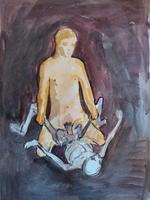
True Love of a Russian Soldier
Kateryna Lysovenko
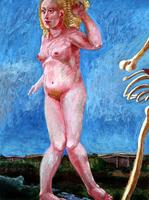
Prehistoric Figure
Charles Garabedian
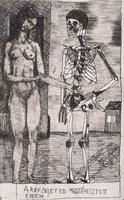
Kondor Béla, a Képzeleted Megtévesztett Engem
Kondor Béla
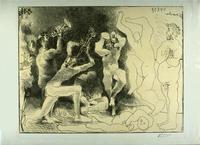
Dance of Fauns
Pablo Picasso
untitled
Toshihiko Okuya
Prayer
Jo Baer
Girl and Death
Edvard Munch
Figuras e bichos
Ivan Serpa
Desnudos
Maria Blanchard
Untitled (Figures, Pieta, Catastrophic Signs)
Salvador Dali
Actresses
Joseph Beuys
Skeleton
Vincent van Gogh
Shot dead
Ozdemir Atlan
Untitled
Zdzislaw Beksinski
Studies of a Female Figure
Noè Bordignon
Riding with Death
Jean-Michel Basquiat
Study of battles on horseback and on foot
Leonardo da Vinci
Possession
Paul-Albert Besnard