Jacek Yerka sanatçısının Spychojumper eseri hakkında uzman analizi
Tarz: Surrealism · Tür: animal painting
Expert Analysis of "Spychojumper" by Jacek Yerka
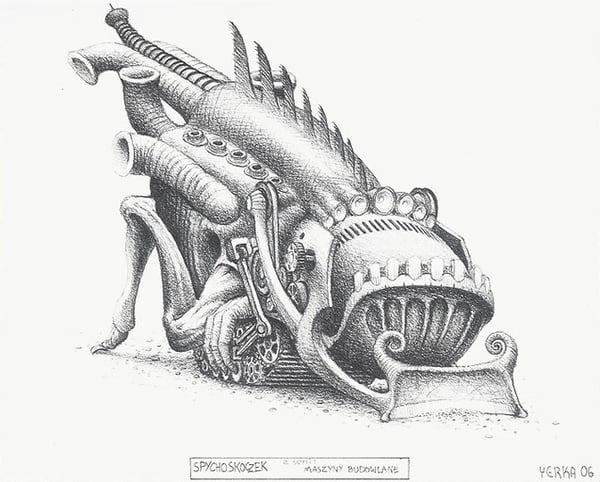
As a surrealist animal painting, Jacek Yerka’s Spychojumper occupies a distinctive intersection of dreamlike fantasy and zoological subject matter. Within the Surrealist movement—which seeks to unlock the subconscious through irrational, often paradoxical imagery—Yerka’s contribution is notable for his capacity to render the impossible with hyperrealistic precision. The work channels a core Surrealist principle: the familiar animal form becomes a vessel for the uncanny, inviting viewers into a world where biological logic is suspended and replaced by poetic, often unsettling metamorphosis.
Significance within Surrealism and the Animal Painting Genre:
-
Recontextualization of the Animal as Surrealist Symbol
In traditional animal painting, the subject is typically observed from nature or used symbolically (e.g., emblematic heraldry). Yerka subverts this by placing animals in scenarios that defy natural laws—an approach that aligns with Surrealism’s goal of liberating the mind from rational constraints. Spychojumper, like many of Yerka’s works, likely presents an animal in a state of hybridity or impossible action, transforming it into a conduit for dream logic and subconscious narrative. -
Precision as a Means of Disruption
Yerka’s style is characterized by meticulous, almost photographic detail—a technique that amplifies the surreal effect. By grounding the fantastic in hyperreal texture and anatomy, he makes the implausible feel tangible. This tension between the recognizable (the animal’s species, fur, form) and the inexplicable (its surroundings, behavior, or modifications) is a hallmark of the best Surrealist painting, and it elevates Spychojumper beyond mere whimsy into a substantive exploration of perception. -
Niche Contribution to the Surrealist Canon
While Surrealism is rich with human figures, still lifes, and landscapes, Yerka’s consistent focus on animals—often placed in intricate, invented architectures—carves a unique niche. Spychojumper exemplifies how the animal becomes a surrogate for human psyche: instinct, freedom, entrapment, or transformation. In this way, the work resonates with Surrealist themes of the unconscious while expanding the genre’s visual vocabulary. -
Period Relevance
As part of the late-20th/early-21st century Surrealist revival (often called Fantastic Realism), Yerka’s Spychojumper reaffirms Surrealism’s enduring power to provoke wonder and introspection. It demonstrates that the movement is not confined to a historical moment but can be continuously revitalized through fresh subject matter—in this case, the surreal animal.
In summary, Spychojumper is significant as a surrealist animal painting because it merges the precision of classical animal portraiture with the irrationality of the dream state, offering a compelling synthesis of two distinct traditions. It embodies Yerka’s ability to make the familiar strange and the strange familiar, a core achievement of Surrealism itself.
Görsel olarak benzer
İlişkili kompozisyon ve renk paletine sahip 20 eser
Topological knife
Jacek Yerka
Shaver Verge
Jacek Yerka
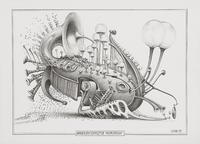
Self-propelled walking composer
Jacek Yerka
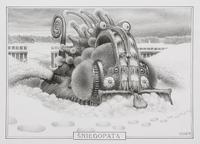
Snovel
Jacek Yerka
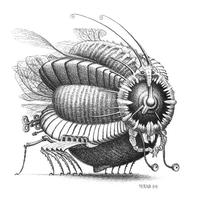
Fly Alarmowka
Jacek Yerka
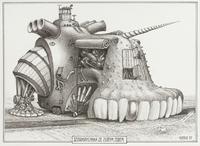
SZOSOGRYZARKA ZE ZŁOTYM ZĘBEM
Jacek Yerka
Narrow Gauge train
Jacek Yerka
Time tuner
Jacek Yerka
Trains of Mister Cat
Jacek Yerka
Tempest
Jacek Yerka
Graviton with motor engine
Jacek Yerka
WINNICZEK OLADROWANY
Jacek Yerka
Chaos riders
Jacek Yerka
Travelling cutter
Jacek Yerka
Caribbean Landscape
Andre Masson
Flight-Clock
Jacek Yerka
Perpetuum Mobile
Wojciech Siudmak
War Games
Jacek Yerka
From the depths of
Jacek Yerka
Desert tram
Jacek Yerka