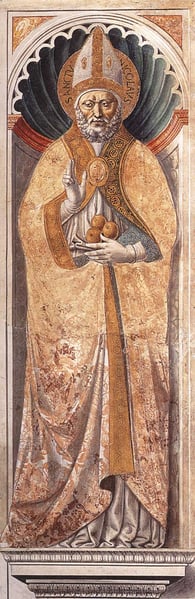
Экспертный разбор работы «St. Nicholas of Bari» художника Benozzo Gozzoli
Стиль: Early Renaissance · Жанр: religious painting
Expert Analysis: "St. Nicholas of Bari" by Benozzo Gozzoli
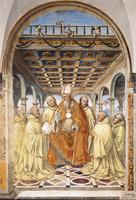
Benozzo Gozzoli’s St. Nicholas of Bari stands as a compelling example of Early Renaissance religious painting, bridging the ornate decorative traditions of the late Gothic period with the burgeoning naturalism of the Quattrocento. Though the work is a single devotional image rather than a grand fresco cycle, it encapsulates Gozzoli’s signature ability to infuse sacred figures with both human tenderness and celestial splendor.
Significance within the Early Renaissance
Gozzoli, best known for the dazzling Procession of the Magi in Florence’s Palazzo Medici-Riccardi, here applies his characteristic finesse to a more intimate canvas. The painting’s significance lies in its synthesis of two competing impulses of the era:
-
Luxurious Decorative Detail – The saint’s elaborate bishop’s vestments, likely rendered with rich gold leaf and meticulous patterning, echo the International Gothic love for surface ornament. This visual opulence was not mere decoration but served to elevate the holy figure, making the divine palpable through material splendor—a key device in Early Renaissance devotional art aimed at inspiring awe and piety.
-
Emergent Naturalism – Unlike purely Gothic icons, Gozzoli softens the saint’s features, giving him a gentle, contemplative expression. The modeling of the face and hands suggests an awareness of volume and light, a nod to the humanistic emphasis on the individual that artists like Masaccio and Fra Angelico had pioneered. This blend of the ideal and the real makes St. Nicholas feel both approachable and transcendent.
Iconographic Relevance
As a depiction of St. Nicholas of Bari (the historical bishop of Myra whose relics were translated to Bari, Italy), the painting would have reinforced the saint’s role as a protector of children, sailors, and the poor. Gozzoli likely includes the saint’s traditional attributes—three golden balls or gold coins (symbolizing his secret gift-giving) and a bishop’s mitre and crozier—though without explicit visual data, we infer their presence. The work’s serene composition and luminous palette reflect the Early Renaissance preference for clarity and grace over the dramatic tension of later periods.
Conclusion
In St. Nicholas of Bari, Gozzoli achieves a delicate equilibrium: the painting’s glittering surfaces and gold backgrounds look backward to medieval iconography, while its softly modeled form and humanized gaze look forward to the High Renaissance. It is precisely this transitional character—rooted in devotional tradition yet reaching toward naturalism—that makes the work significant within the Early Renaissance canon, demonstrating how sacred art could be both spiritually uplifting and visually captivating.
Museum / Gallery
Визуально похожие
20 работ с близкой композицией и палитрой
St. Fina
Benozzo Gozzoli
St. Gimignano
Benozzo Gozzoli
Sixtus II
Sandro Botticelli
Pope Fabiano
Pietro Perugino
St. Alberto of Trapani
Filippo Lippi
St. Bartolus
Benozzo Gozzoli
St. Monica
Benozzo Gozzoli
Raphael and Tobias
Benozzo Gozzoli
Pope Antero
Pietro Perugino
St.Paul
Paolo Uccello
St. Antony
Domenico Ghirlandaio
St. Nicholas of Tolentino
Benozzo Gozzoli
St. Augustine in his cell
Sandro Botticelli
St Augustine
Sandro Botticelli
St.Dominic
Paolo Uccello
Madonna and Child with St. Sebastian and St. Julian
Domenico Ghirlandaio

St. Stephen the Martyr
Domenico Ghirlandaio
Saint Mary Magdalen
Piero della Francesca
St. Barbara
Domenico Ghirlandaio
The Confirmation of the Olivetan Order by the Bishop of Arezzo
Il Sodoma