
Analisi esperta di View of the Left Hand Wall of the Chapel di Benozzo Gozzoli
Stile: Early Renaissance · Genere: religious painting
Expert Analysis of "View of the Left Hand Wall of the Chapel" by Benozzo Gozzoli
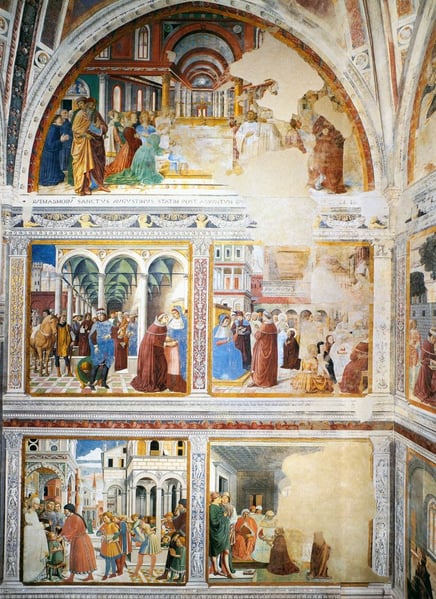
Benozzo Gozzoli’s View of the Left Hand Wall of the Chapel is a fragment of one of the most celebrated fresco cycles of the Early Renaissance: the Procession of the Magi in the chapel of the Medici-Riccardi Palace in Florence (c. 1459–1461). Though identified here as a “religious painting,” it is in fact a monumental fresco that transforms biblical narrative into a dazzling showcase of Florentine courtly life, political symbolism, and artistic innovation.
Significance within the Early Renaissance Style
-
Synthesis of Sacred and Secular: Gozzoli’s fresco is a quintessential Early Renaissance fusion of religious subject and contemporary pageantry. The journey of the Magi (the three kings traveling to Bethlehem) becomes an allegorical procession of the Medici family and their allies. On the left-hand wall, the viewer sees a crowd of figures, many bearing identifiable portraits of Medici patrons (e.g., Piero de’ Medici, Lorenzo the Magnificent as a boy) and visiting dignitaries. This blurring of holy history with modern political power was a bold statement of Medici authority and piety, a hallmark of Early Renaissance patronage.
-
Mastery of Narrative Continuity: Unlike earlier Gothic cycles that compartmentalized scenes, Gozzoli spreads the Magi’s journey across three walls in a continuous, frieze-like composition. The left wall depicts the first king’s retinue, moving dynamically toward the altar. The landscape—a fantastical Tuscan hillside dotted with castles, trees, and animals—guides the eye from left to right, unifying the space. This narrative flow anticipates the later Renaissance interest in perspective and spatial coherence.
-
Exquisite Detail and Color: Gozzoli’s palette is exceptionally rich, with deep blues, gold leaf, and vibrant reds—materials that signaled luxury and were costly to procure. The left wall is dense with intricate details: brocaded fabrics, jewels, exotic animals (leopards, horses, camels), and individualized faces. This love of minute ornamentation reflects the influence of International Gothic, but Gozzoli tempers it with a more naturalistic treatment of figures and landscape, characteristic of the Early Renaissance’s move toward observation.
-
Decorative Unity and the Chapel as a Gesamtkunstwerk: The entire chapel—walls, vault, and altar—was conceived as a unified visual program. The left wall echoes the right in symmetry and rhythm, while the blue vault with stars and angels ties the space together. Gozzoli’s work is thus significant not just as a painting but as an immersive environment, blending architecture, fresco, and gold leaf to create a celestial court on earth.
What Makes This Artwork Stand Out
-
Portraiture as Political Propaganda: The left wall contains some of the earliest Renaissance portrait groups in a religious context. By inserting living patrons into the biblical scene, Gozzoli asserts the Medici family as rightful spiritual and earthly rulers—a sophisticated use of art for dynastic legitimation.
-
Technical Brilliance: Gozzoli’s fresco technique is remarkable for its preservation of vivid color and fine detail. The use of buon fresco (painting on wet lime plaster) combined with dry a secco touches for highlights allowed for minute patterning, especially in costumes.
-
Influence on Later Secular Frescoes: This cycle directly influenced later Renaissance murals in princely courts (e.g., the Camerin of Isabella d’Este) and even Baroque theatrical processions. It demonstrates how religious painting could serve as a vehicle for secular celebration without losing its devotional function.
In sum, View of the Left Hand Wall of the Chapel is a seminal work of the Early Renaissance because it epitomizes the period’s genius for integrating spiritual narrative, contemporary politics, decorative splendor, and nascent naturalism. Gozzoli’s masterpiece remains a vivid testament to the Medici’s vision of Florence as a new Jerusalem—and to the artist’s own skill in making faith, power, and beauty inextricable.
Museum / Gallery
Visivamente simili
20 opere con composizione e palette affini
View of the Right Hand Wall of the Chapel
Benozzo Gozzoli
Cappella Rinuccini
Giovanni da Milano
Scenes from the Lives of Sts. Lawrence and Stephen
Fra Angelico
Cappella Rinuccini
Giovanni da Milano
Blessing of the Faithful at Hippo
Benozzo Gozzoli
Scenes from the Life of Magdalene
Giovanni da Milano
Upper Portions of the East (window) Wall
Benozzo Gozzoli
Cappella Rinuccini
Giovanni da Milano
Life of St Benedict, Scene 19. Benedict Sends Away the Harlots
Il Sodoma
View of east wall of the chapel
Fra Angelico
Scenes from the Life of the Virgin
Giovanni da Milano
Scenes from the Life of St. Francis (south wall)
Benozzo Gozzoli
Cappella Rinuccini
Giovanni da Milano
Life of St Benedict, Scene 3. Benedict Repairs a Broken Colander Through Prayer
Il Sodoma
Disputation in the Synagogue
Filippo Lippi
Life of St Benedict, Scene 13. Benedict Frees a Monk
Il Sodoma
View of the Apsidal Chapel of Sant'Agostino. Cycle of St. Augustine
Benozzo Gozzoli
The Annunciation
Pinturicchio
Annunciation to Zacharias
Giotto
Ascension of the Evangelist
Giotto