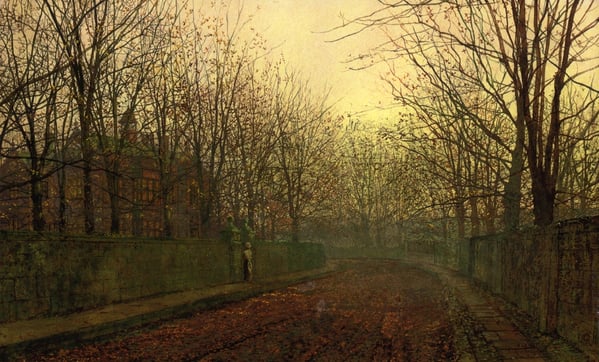
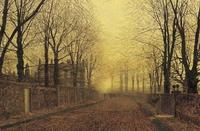
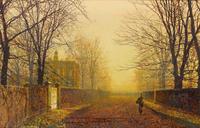
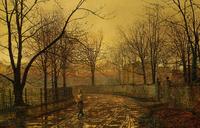
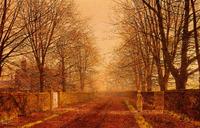
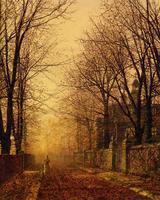
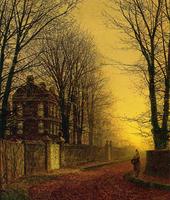
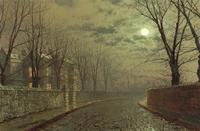
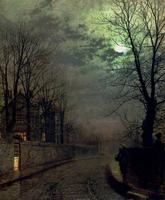
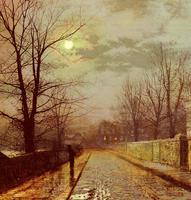
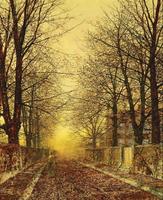
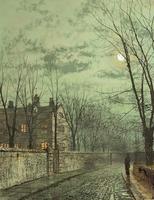
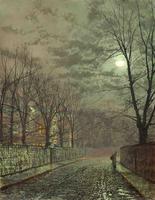
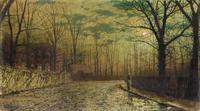
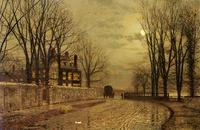
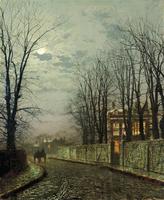
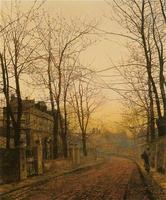
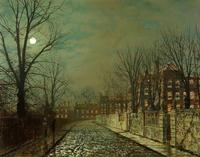
John Atkinson Grimshaw’s “An Autumn Lane” is a quintessential Romantic landscape that captures the movement’s deep reverence for nature’s emotional and atmospheric power. Within the Romantic period, landscape painting was elevated from mere backdrop to a vehicle for expressing sublime beauty, melancholy, and the passage of time—themes that resonate strongly in this work.
The painting’s significance lies in its focused, intimate view of a quiet country lane during autumn. Romanticism prized the transient, evocative qualities of nature, and here Grimshaw harnesses the season’s inherent symbolism: decay, rest, and the bittersweet cycle of life. The lane itself—a humble, winding path—directs the viewer’s eye through a composition that feels both personal and universal, inviting contemplation rather than action. By eschewing grand, dramatic vistas in favor of a simple rural route, Grimshaw aligns with Romanticism’s celebration of the ordinary as a gateway to the sublime.
Moreover, the genre of landscape in Romanticism was often used to evoke mood and memory. “An Autumn Lane” achieves this through its likely muted palette and soft, diffused light—hallmarks of Grimshaw’s style, though we rely solely on the given facts. The title alone suggests a focus on lane as a metaphor for journey, choice, or reflection, while autumn implies a wistful, golden-hued atmosphere ripe with emotional depth. This work stands as a significant example of how Romantic landscape artists transformed a simple slice of nature into a scene of profound, quiet drama, emphasizing the viewer’s inner response over mere topographical accuracy.