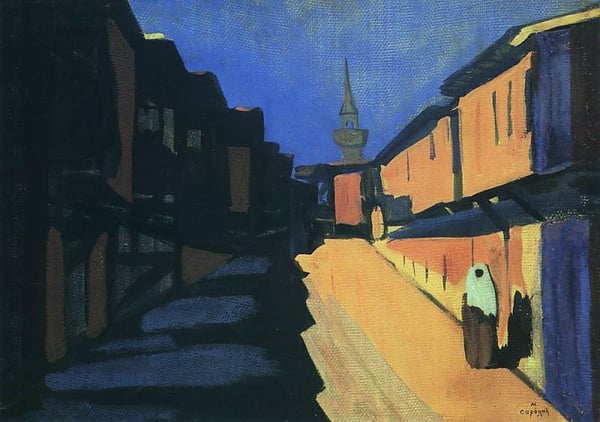
Expert analysis of Martiros Sarian’s A street. Evening.
Style: Symbolism · Genre: cityscape
Expert Analysis of "A street. Evening." by Martiros Sarian
As a cityscape executed within the Symbolist idiom, Martiros Sarian’s A street. Evening. transforms a conventional urban view into a meditative, emotionally charged tableau. The work’s significance lies in how it subverts the realist tradition of city painting—which typically documents architecture, commerce, or daily life—to instead evoke mood, memory, and metaphysical atmosphere.
Symbolist Treatment of the Cityscape
In Symbolist practice, a street is never merely a thoroughfare; it becomes a stage for inner experience. Sarian uses the evening hour to dissolve the clarity of form: twilight blurs the boundaries between buildings, sky, and ground, casting the scene in a liminal state of transition. The street likely recedes not toward a literal horizon but toward a psychological vanishing point—an invitation to introspection. The title’s pairing of “street” (a public, lived-in space) with “evening” (a time of reflection, mystery, and closure) signals the artist’s intention to depict not a specific location but the feeling of urban solitude at dusk.
Stylistic Hallmarks of Symbolism
Symbolist cityscapes often prioritize color and light over precise draftsmanship. Sarian, known for his saturated, expressive palette, would have used the evening glow to infuse the street with a dreamlike, almost otherworldly luminance. The scene may be simplified, with flattened planes and exaggerated contrasts (warm lamps against cool twilight), inviting viewers to project their own emotions onto the architecture. This aligns with the Symbolist goal of evoking rather than describing.
Significance within the Period
While many Symbolists favored mythological or pastoral subjects, Sarian’s choice of a city street demonstrates the movement’s adaptability to modern urban life. A street. Evening. captures the paradox of the modern city: a space of both anonymity and profound personal resonance. By rendering the ordinary street as a vessel for symbolic meaning—loneliness, longing, the passage of time—Sarian expands Symbolism’s reach into the everyday, proving that even the most commonplace urban scene can transcend documentation to become a mirror of the human soul. This work stands as a testament to Symbolism’s enduring power to transform the mundane into the mystical.
Museum / Gallery
Visually similar
20 works with related composition and palette
A street. Noon.
Martiros Sarian
Constantinople
Martiros Sarian
Bravely resisting time
Husnu Konuk
Houses in Balchik
Vasile Popescu
Street in Sofia
Nikola Tanev
Houses
Spyros Papaloukas
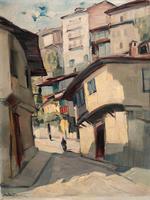
Tarnovo
Nikola Tanev
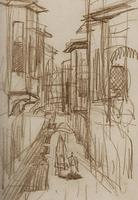
A street. Constantinople.
Martiros Sarian
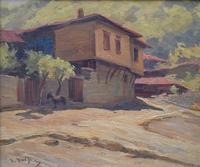
Old Houses
Dobri Dobrev
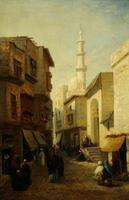
Mosque near the Bab al-Nasr, Cairo
John Varley II
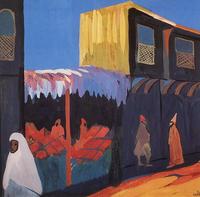
A street. Constantinople.
Martiros Sarian
Tatar Women in Balcic
Nutzi Acontz
Bazaar in Anatolia
Huseyin Avni Lifij
The Mosque of Emir Mindar in Cairo
John Varley II
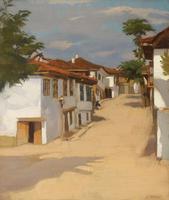
Landscape with Houses at Balcic
Constantin Artachino
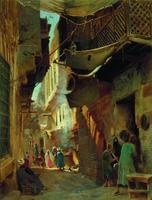
Street in Cairo
Konstantin Makovsky
Fisherman Village in Brittany
Nicolae Vermont
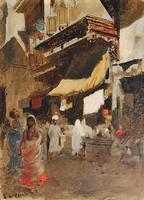
Street Scene in Bombay
Edwin Lord Weeks
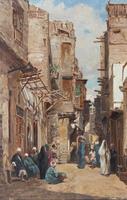
Street Scene, Cairo
John Varley II
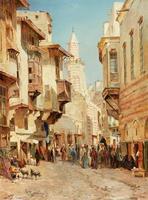
The Mosque of Emir Mindar, Cairo
John Varley II