Expert analysis of Joseph Wright’s Landscape Study Development from a Blot
Style: Baroque · Genre: landscape
Analysis of "Landscape Study Development from a Blot"
Joseph Wright (of Derby), Baroque period, landscape genre
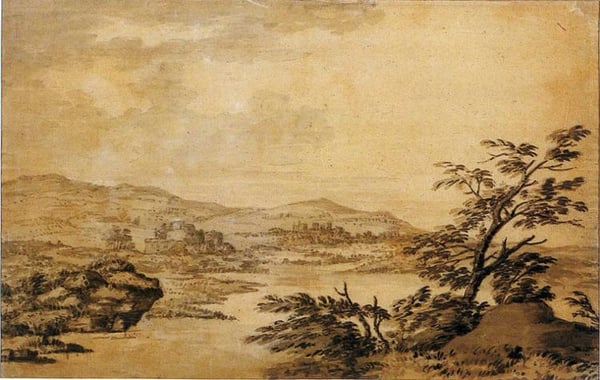
Joseph Wright’s Landscape Study Development from a Blot is a striking example of how Baroque dynamism merges with the experimental creative processes that would later anticipate Romanticism. The work is significant for its method: Wright engages directly with the contemporary "blot" technique popularized by Alexander Cozens, wherein an accidental ink stain serves as the germ of a composition. Instead of beginning with a preconceived scene, Wright lets the random blots suggest natural forms—perhaps a craggy hillside, a gnarled tree, or a stormy sky—and then he develops them into a coherent landscape through careful Baroque chiaroscuro and dramatic contrasts.
What makes this piece remarkable within the Baroque landscape tradition is its dual emphasis on invenzione (inventive imagination) and natura (observed nature). Wright does not simply copy a real vista; he coaxes order from chaos, mirroring the Baroque fascination with the interplay of light and darkness, structure and turbulence. The finished study likely retains a sense of spontaneity, with loose brushwork and stark tonal shifts that evoke the theatricality of a storm or the sublime power of an untamed scene. This approach reflects Wright’s broader interest in the interplay between the rational and the accidental—a theme also present in his famous scientific and industrial works.
In the context of 18th-century British art, Landscape Study Development from a Blot stands as a bridge between the formal landscapes of Claude Lorrain (still influential in the Baroque) and the more subjective, emotive landscapes of the later Romantics. Wright’s willingness to embrace the blot as a starting point reveals a forward-thinking attitude: the artist’s hand and mind are active partners in creation, not mere copyists. The significance thus lies in how the work synthesizes Baroque theatricality with a proto-Romantic trust in imagination, making it a crucial document of artistic process and a testament to Wright’s innovative spirit.
Visually similar
20 works with related composition and palette
Trees
Claude Lorrain
A Forest Pool
Paul Bril
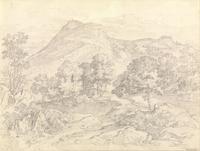
A View of Civitella from the Serpentara next to Olevano
Heinrich Reinhold
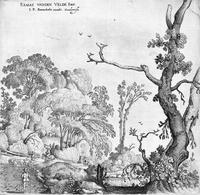
Landscape
Esaias van de Velde
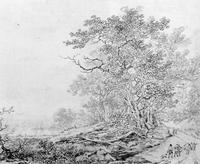
Mountainous landscape with travellers Sun__Mountainous-landscape-with-travellers
Jacob van Strij
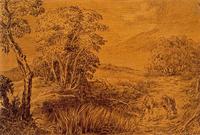
A Village in Summerset
Giorgio de Chirico
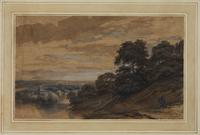
Landscape with a Wayfarer
Adam Elsheimer
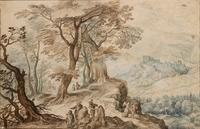
Landscape with Tobias and the Angel
Jan Brueghel the Younger
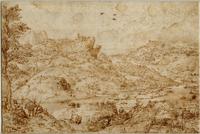
Mountain landscape with a river
Pieter Bruegel the Elder
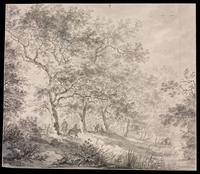
Row of Trees
Jan Dirksz Both
Running away the Mother of God into Egypt
Pieter Bruegel the Elder
A Village in Summerset
Giorgio de Chirico
Travelling Couple with Dog in an Arcadian Landscape
Johann Christoph Haffner
View
Robert Sayer
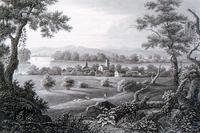
New Harmony
Karl Bodmer
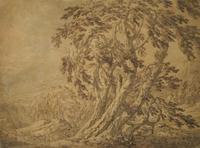
Forest Scene
Salvator Rosa
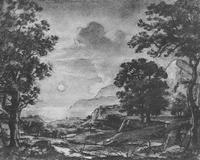
Romantic landscape
Konstantin Bogaevsky
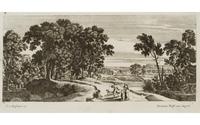
Travelling Family in Arcadian Landscape
Johann Christoph Haffner
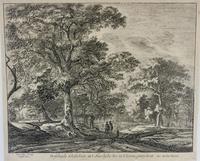
Verscheijde Ghesichten, in 't Haechsche Bosch na 't Leven geteyckent
Roelant Roghman
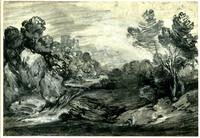
Rocky wooded landscape with waterfall, castle and mountain,
Thomas Gainsborough