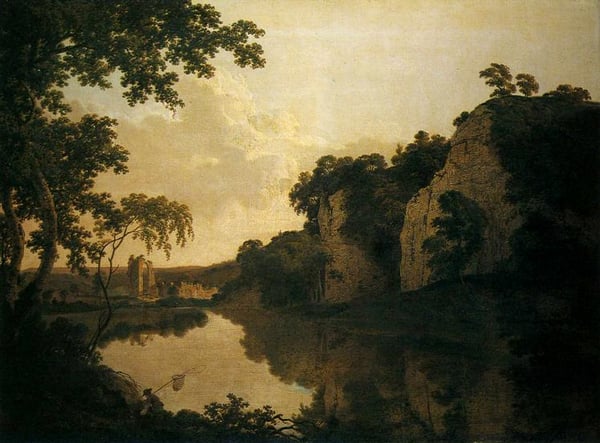
Landscape with Dale Abbey
Expert analysis of Joseph Wright’s Landscape with Dale Abbey
Style: Romanticism · Genre: landscape
Expert Analysis: "Landscape with Dale Abbey" by Joseph Wright
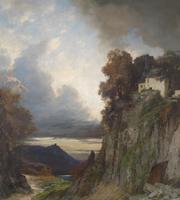
Joseph Wright of Derby (1734–1797) is celebrated for his masterful manipulation of light and shadow, a skill that bridges the academic precision of the 18th century with the emotive power of Romanticism. Landscape with Dale Abbey, painted circa 1785–1790, stands as a compelling example of Wright’s contribution to the Romantic landscape tradition—distinct from his more famous industrial and candlelit scenes.
Significance within Romanticism and Landscape Genre
-
The Romantic Ruin: The painting features the Gothic ruins of Dale Abbey in Derbyshire, a medieval Augustinian monastery dissolved under Henry VIII. In Romantic art, ruins were not mere historical relics; they symbolized the sublime passage of time, human transience, and nature’s reclamation of human ambition. Wright presents the abbey’s skeletal arches and crumbling walls not as a precise architectural record but as a poetic, melancholic presence embedded within a verdant, living landscape. This aligns with the Romantic fascination with the genius loci (spirit of place) and the emotional resonance of decay.
-
Atmospheric Light and the Sublime: Wright’s signature chiaroscuro is here softened into a luminous, naturalistic glow that suffuses the scene with a tranquil, almost melancholic air. The low, warm light of late afternoon or early morning filters through the trees and plays across the abbey stones, creating a sense of both intimacy and vastness. This treatment of light evokes the “natural sublime”—the idea that nature’s beauty can inspire awe and spiritual reflection. Unlike his dramatic An Experiment on a Bird in the Air Pump, this is a quiet, meditative sublime, more akin to the landscapes of J.M.W. Turner or John Constable’s later work.
-
Integration of History and Nature: Wright deliberately situates the abbey within a working rural landscape. A figure (perhaps a local shepherd or traveler) and grazing cattle occupy the foreground, their small scale emphasizing the monumental weight of the ruins and the overarching sky. This juxtaposition reflects the Romantic concern with humanity’s place in a world shaped by both history and nature. The abbey is not a sterile monument; it is a living part of the countryside, softened by moss and framed by trees, suggesting a harmonious, if poignant, coexistence.
-
Contribution to British Landscape Painting: While Wright is often pigeonholed as a painter of the Industrial Revolution, Landscape with Dale Abbey demonstrates his capacity for pure landscape and his engagement with the broader Romantic movement. The painting anticipates the “picturesque” and “sublime” theories championed by Edmund Burke and later artists, and it prefigures the more overtly emotive landscapes of the 19th century. It is significant as a record of Wright’s deep attachment to his native Derbyshire and his ability to transform a local view into a universal meditation on time, mortality, and the enduring beauty of the natural world.
In short, Landscape with Dale Abbey matters because it reveals Joseph Wright as a fully fledged Romantic landscape painter—not merely a master of artificial light, but a profound poet of natural light and historical atmosphere. It is a quiet masterpiece of the Romantic sensibility, where a crumbling abbey becomes a mirror for the soul’s contemplation of eternity.
Visually similar
20 works with related composition and palette
View in Matlock Dale, Looking Towards Black Rock Escarpment
Joseph Wright
Catnip Island, Near Greenwich, Connecticut
David Johnson
Pêcheurs devant une rivière traversant un paysage de rochers boisés
Michael Wutky
A mountainous river landscape with figures on a track
Daniël Dupré
A Classical Landscape
Thomas Jones
Afternoon along the Banks of a River
David Johnson
Sandy Track in the Dunes
Jacob van Ruisdael

Catskill Landscape
Thomas Cole
A River Landscape Flanked by Trees
George Lambert
Paesaggio Con Figure in Riva Al Fiume Adda
Marco Gozzi
On the Esopus Creek, Ulster County, New York
David Johnson
Mountainous landscape
Jacob Savery the Elder
Matlock Tor by Daylight
Joseph Wright
High Tor, Matlock
John Crome
An extensive river landscape with travellers on horseback
Thomas Barker of Bath
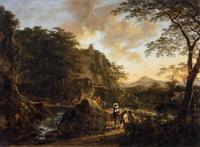
Landscape with a Peasant Woman on a Mule
Jan Dirksz Both
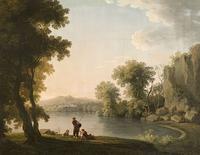
Groupe de pêcheurs au bord d'un lac
Michael Wutky
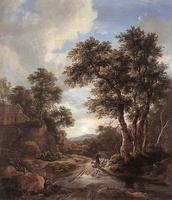
Sunrise in a Wood
Jacob van Ruisdael
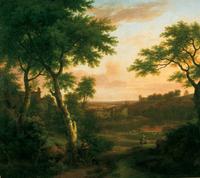
The Ruins of Rievaulx Abbey, Yorkshire
George Lambert
Evening mood on the Rhine (Koblenz)
Albert Flamm