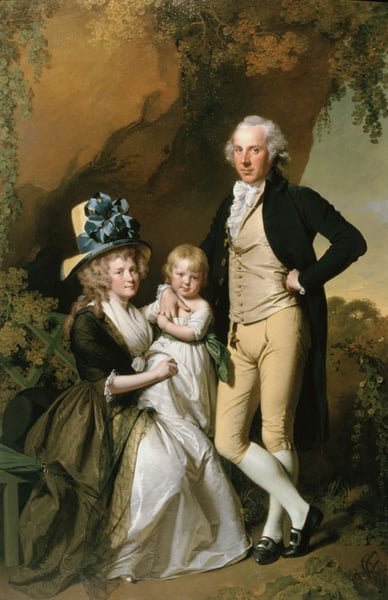
Portrait of Richard Arkwright Junior with his Wife Mary and Daughter Anne
Details
Expert analysis of Joseph Wright’s Portrait of Richard Arkwright Junior with his Wife Mary and Daughter Anne
Style: Rococo · Genre: portrait
Analysis of "Portrait of Richard Arkwright Junior with his Wife Mary and Daughter Anne" by Joseph Wright
As a Rococo portrait, this work exemplifies the style's characteristic emphasis on intimacy, softness, and refined domestic elegance. Rococo portraiture often moved away from formal grandiosity toward more personal, affectionate family scenes, and Wright captures that shift here. The composition—three figures arranged in a close, harmonious grouping—conveys a sense of familial warmth and unity, typical of the period’s interest in private sentiment.
The painting’s significance within the Rococo style lies in its blend of aristocratic grace with the emerging industrial gentility of the late 18th century. The sitters—Richard Arkwright Junior, his wife Mary, and their daughter Anne—belong to a newly wealthy manufacturing family (the Arkwrights were pioneers of the textile industry). By depicting them in a Rococo manner, Wright subtly elevates their social standing, aligning them with the leisurely, cultured world of the traditional nobility. The use of soft, flowing lines, delicate color harmonies, and the subtle play of light on their faces and garments are hallmarks of Wright’s adaptation of Rococo elegance, even as he brings a characteristically naturalistic attention to human expression.
Moreover, Joseph Wright was renowned for his dramatic chiaroscuro (often associated with his later industrial scenes), but here he channels that sensitivity toward a gentler, more decorative effect. The tender interaction between mother and child, and the father’s protective presence, reinforces the Rococo ideal of the family as a site of affection and refinement. This portrait thus stands as a significant example of how Rococo conventions were adapted to celebrate not just aristocratic lineage, but the new bourgeois domesticity—a key cultural shift that the style helped to articulate.
Visually similar
20 works with related composition and palette
John Cadwalader Family
Charles Willson Peale
Benjamin and Eleanor Ridgley Laming
Charles Willson Peale
Nathaniel Curzon (1726–1804), 1st Baron Scarsdale, and His Wife Lady Caroline Colyear (1733–1812), Lady Scarsdale, Walking in the Grounds at Kedleston
Nathaniel Hone the Elder
D'Ewes Coke, His Wife Hannah and Daniel Parker Coke
Joseph Wright
Moritz Christian Reichsgraf Von Fries Mit Seiner Frau Maria Theresia Josepha
François Gérard
51491626901 42e4effb28 B
Charles-Nicolas Guillon
Retrato de Jacob Ferdinand Dufour Feronce
Johann Friedrich August Tischbein
Portrait of A. G. and A. A. Lobanov Rostovsky
Vladimir Borovikovsky
Charles Watson, Esq., and His Wife, Lady Mary, with Their Two Children, James and Anne in a Landscape
David Allan
Ferdinand IV of Naples and his family
Angelica Kauffman
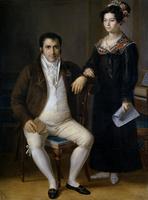
Don Pedro Benítez and His Daughter María de la Cruz
Rafael Tegeo
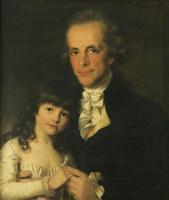
Colonel James Capper and His Daughter
John Russell
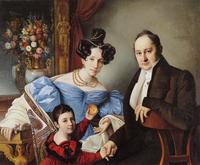
The Brucker family
Giuseppe Tominz
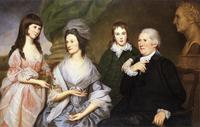
Robert Goldsborough and Family
Charles Willson Peale
George Grenville, Earl Temple, Mary, Countess Temple, and Their Son Richard
Joshua Reynolds
Anna Maria Jenkins and Thomas Jenkins
Angelica Kauffman
John Johnstone, Betty Johnstone, and Miss Wedderburn
Henry Raeburn
Peter Perez Burdett and his First Wife Hannah
Joseph Wright
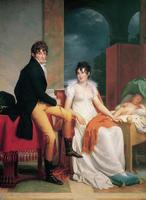
Moritz Christian Reichsgraf Von Fries with His Wife Maria
François Gérard
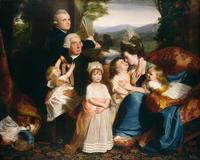
The Copley Family
John Singleton Copley