Expertenanalyse zu Joseph Wrights Sir Richard Arkwright
Stil: Baroque, Romanticism · Genre: portrait
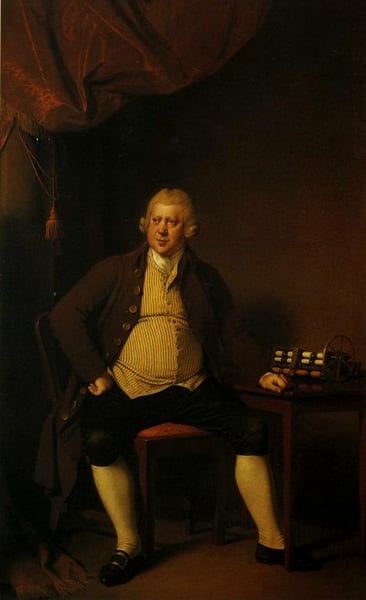
Expert Analysis: "Sir Richard Arkwright" by Joseph Wright (c. 1789–1790)
This portrait occupies a pivotal position at the intersection of late Baroque theatricality and emerging Romantic sensibility, while also serving as a visual manifesto of the Industrial Revolution. Joseph Wright of Derby, renowned for his dramatic chiaroscuro and scientific subjects, here applies his masterful tenebrist technique to a titan of industry rather than a saint or aristocrat.
Baroque Legacy
The Baroque influence is immediate in the stark, Caravaggesque lighting that carves Arkwright’s face and hands from a shadowed ground. The diagonal beam of light—reminiscent of Wright’s own An Experiment on a Bird in the Air Pump—imbues the sitter with a nearly sacred gravity. The half-length format, direct gaze, and authoritative gesture (the hand resting on what appears to be a document or a model of his spinning frame) recall the portraiture of Van Dyck or Rembrandt, but the subject is not a king or scholar: he is a self-made entrepreneur.
Romantic Innovation
Romanticism’s celebration of the individual, especially the visionary genius, finds its industrial avatar in Arkwright. Wright elevates the inventor-capitalist to heroic status, painting him not in the powdered wig and satin of a courtier but in the plain, functional coat of a man of action. The intense, almost introspective expression—the eyes directed slightly away from the viewer—hints at a mind consumed by mechanical innovation and economic calculation. This interiority is a Romantic trait: the sitter is not merely posing but thinking.
Historical Significance
What makes this work truly significant is its role as a portrait of industrial power at the very moment when such power was reshaping Britain. Arkwright’s water frame had revolutionized cotton spinning, and Wright, a painter deeply attuned to the scientific and technological currents of his age, translates that revolution into paint. The Baroque drama serves the Romantic ideal of the heroic inventor—a figure who, like Wright’s earlier subjects in scientific demonstrations, bridges the worlds of art, industry, and human ambition.
In this synthesis, the painting becomes an enduring symbol of the Enlightenment’s rational progress merging with Romanticism’s emotional intensity—a visual statement that the factory floor and the inventor’s mind deserve the same grand treatment as the battlefield or the biblical scene.
Museum / Gallery
Visuell ähnlich
20 Werke mit ähnlicher Komposition und Farbpalette
Jedediah Strutt
Joseph Wright
Portrait of Joseph Warren
John Singleton Copley
Dr John Matthews
George Romney
Louis De Visme
Anton Raphael Mengs
John Smith (1703–1787)
George Romney
Yuri Matveevich Veldten
Carl-Ludwig Johann Christineck
Richard Pennant (1737–1808), Baron Penrhyn of Penrhyn
George Romney
Sir John Trevelyan (1734–1828), 4th Bt
George Romney
Mr. James Bourdieu
Joshua Reynolds
William Vassall and His Son Leonard
John Singleton Copley
Abraham Rawlinson (1738–1803), MP, of Ellel Hall, near Lancaster
George Romney
Portrait of a Young Man in a Green Jacket
David Allan
Samuel Verplanck
John Singleton Copley
Sir Thomas Rumbold (1736–1791), Bt
George Romney
John Bours
John Singleton Copley
William James
Joshua Reynolds
Portrait of Robert Shafto, called 'Bonnie Bobbie Shafto'
Joshua Reynolds
Christopher Heath
Joseph Wright
John Bellamy
Charles Turner
Isaac Smith
John Singleton Copley