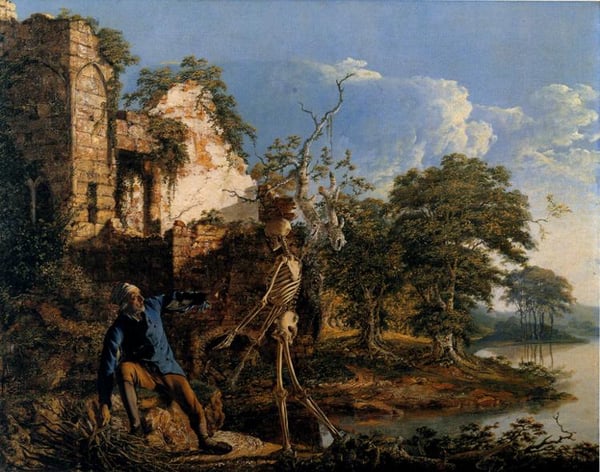
"The Old Man and Death" by Joseph Wright, classified under the Romantic style and as a symbolic painting, gains its significance from how it embodies key Romantic preoccupations through visual allegory. Within the Romantic period, symbolic painting served as a powerful vehicle for exploring profound human experiences—mortality, frailty, and the confrontation with the sublime or the unknown. Wright’s use of this genre allows the artwork to move beyond mere narrative into a moral or philosophical meditation, a hallmark of Romanticism’s emphasis on intense emotion and individual reflection. The work’s significance lies in its capacity to distill universal themes—such as the tension between life’s burdens and the fear of death—into a single, evocative image, reinforcing Romanticism’s focus on the inner life and the symbolic resonance of everyday human struggles.