Expert analysis of Joseph Wright’s Ullswater
Style: Baroque · Genre: landscape
Expert Analysis of "Ullswater" by Joseph Wright
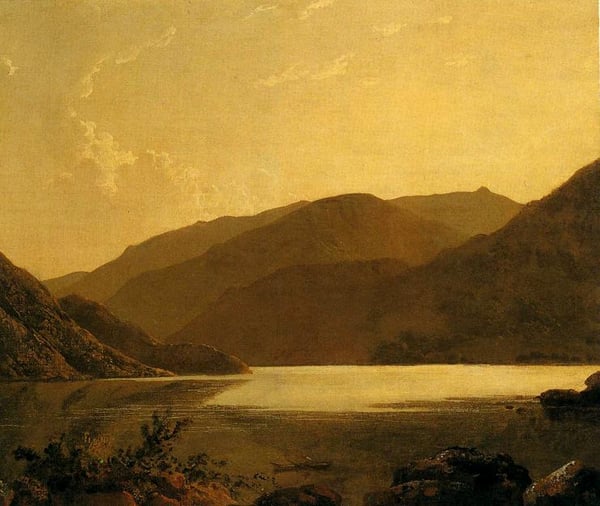
Joseph Wright’s Ullswater stands as a compelling example of the Baroque landscape, a genre that elevated nature through dramatic contrast, emotional resonance, and a sense of the sublime. While Wright is celebrated for his candlelit interiors and industrial scenes—hallmarks of his Enlightenment-era curiosity—this work demonstrates his command of the natural world within the Baroque idiom, marking a significant bridge between the movement’s grand theatricality and the emerging Romantic sensibility.
Baroque Landscape Characteristics and Wright’s Innovation
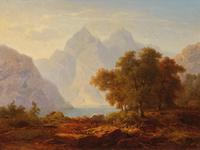
In typical Baroque landscapes, artists like Claude Lorrain and Salvator Rosa used chiaroscuro and sweeping compositions to evoke either idyllic harmony or wild, untamed power. Wright’s Ullswater engages with the latter tradition, capturing the Lake District’s rugged terrain with a dramatic light that seems both natural and almost supernatural. The painting’s significance lies in how it fuses Baroque intensity with proto-Romantic awe—the dense, dark foreground of rocky banks and gnarled trees contrasts sharply with the luminous, silver-blue expanse of Ullswater and the distant mountains. This stark division of light and shadow, a signature Baroque device, pushes the viewer’s eye toward the distant peaks, suggesting a journey from earthly darkness into a transcendent, even spiritual, horizon.
Why “Ullswater” Matters Within the Baroque Period
Wright was a master of capturing fleeting natural effects—here, the glow of sunset or the sudden parting of storm clouds over Cumbria. Ullswater is significant because it imbues a specific, topographically accurate location with the universal Baroque yearning for the sublime. Unlike the idealized pastorals of earlier Baroque painters, Wright’s landscape feels grounded in direct observation, yet his handling of light (a hallmark of his broader oeuvre) transforms the scene into a stage for nature’s grandeur. The rough, almost painterly brushwork in the foliage and rocks echoes the tactile energy of Baroque painting, while the cool, silvery palette anticipates 18th-century Romanticism. In this sense, Ullswater is a pivotal work: it uses Baroque drama not merely for spectacle, but to probe the emotional and psychological impact of the British landscape, helping to shift the genre from decorative backdrop to a vehicle for profound experience.
Museum / Gallery
Visually similar
20 works with related composition and palette
The Heron's Haunt
John Atkinson Grimshaw
Placid Lake, Adirondacks
David Johnson
Lake George
John Frederick Kensett
Landscape view in Cumberland
John Glover
A Scottish Loch
Sidney Richard Percy
Autumn Landscape
Thomas Moran
Winter Landscape
Edwin Lord Weeks

In the Adirondacks
Ralph Blakelock
An Italian Landscape with Mountains and a River
Joseph Wright
MOUNTAIN LANDSCAPE
John Falconar Slater
In the Adirondacks
William Hart
View on the Androscoggin River, Maine
David Johnson
Lac Leman
Alexandre Calame
Loch Achray
Sam Bough
Sunset in the Wilderness
Sanford Robinson Gifford
Bird Mountain Hestmand
Knud Baade
View at Riva, Italian Tyrol
Camille Corot
A View of a Lake in the Mountains
George Caleb Bingham
Mount Washington
Albert Bierstadt
Am Königssee
Carl Millner