Expert analysis of Olexandr Archipenko’s Head of a Woman
Style: Cubism · Genre: sculpture
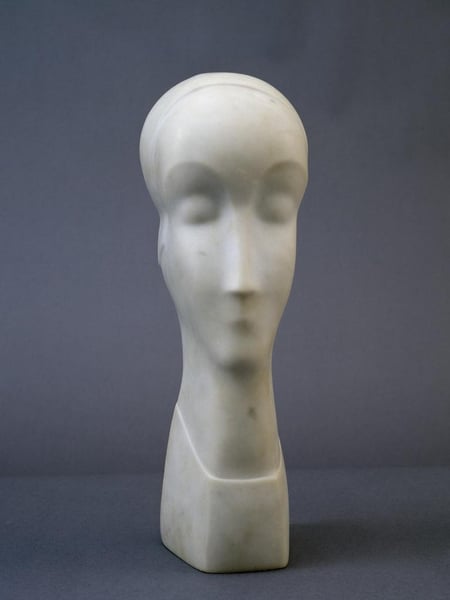
As an expert art historian, I can place Olexandr Archipenko's "Head of a Woman" at a pivotal moment in the evolution of modern sculpture. Executed within the Cubist idiom, this work is significant not merely as a stylistic exercise but as a foundational redefinition of sculptural language.
Breaking the Solid Mass: The first and most radical significance of this sculpture lies in its use of negative space. Archipenko famously introduced the concept of "void" or "concave form" as a positive, expressive element. In Head of a Woman, the features—particularly the eyes, mouth, and the sweeping curve of the jaw—are often rendered as deep, concave hollows rather than protruding volumes. This inversion directly translates Cubist painting's fragmentation of form into three dimensions. Instead of modeling the face as a solid block, Archipenko carves absence to define presence, suggesting that the space around and through the form is as essential as the material itself.
Synthesis of Planes and Angles: True to Cubist principles, Archipenko abandons a single, fixed viewpoint. The head is constructed from sharp, faceted planes that collide and intersect. A profile may merge unexpectedly with a frontal view; a cheekbone becomes a geometric edge. This creates a dynamic, almost kinetic experience for the viewer, who must walk around the piece to reassemble the fragmented image in their mind. It is a sculptural realization of the Cubist ambition to show an object from multiple perspectives simultaneously, collapsing time and space into a single, cohesive composition.
Transition from Representation to Construction: "Head of a Woman" is significant as a bridge between traditional sculpture (centered on the likeness of a sitter) and the modern concept of the "constructed" object. Archipenko was not interested in a realistic portrait; he was interested in the rhythm of volumes and voids. The work is a study in abstract equilibrium—how a steeply angled plane can balance a deep, shadow-filled cavity. This moves sculpture away from the imitation of nature and toward an autonomous, self-referential language of form. It is a direct antecedent to the fully abstract, constructed sculptures of the later 20th century.
In the context of Cubist sculpture, Archipenko stands alongside Picasso and Laurens, but his specific contribution—the poetic and structural use of the void—makes "Head of a Woman" a landmark. It demonstrates that Cubism was not just a painterly revolution; it was a complete rethinking of how to build an object in space, treating the air itself as sculptural material.
Visually similar
20 works with related composition and palette
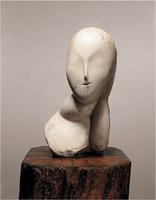
Muse
Constantin Brâncuși
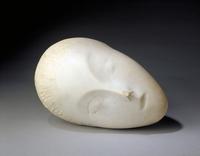
Sleeping Muse
Constantin Brâncuși
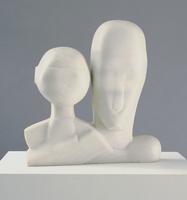
Mother and Child
Jacob Epstein
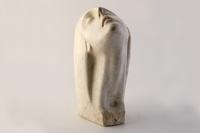
Éxtasis
Kalato
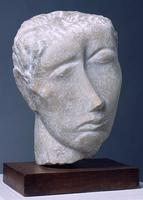
Human head
Ossip Zadkine
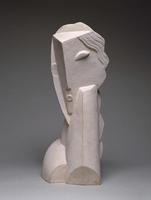
Head of a Young Girl
Henri Laurens
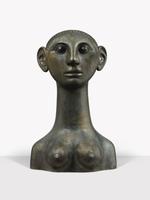
La Femme Aux Grandes Oreilles
Anton Prinner
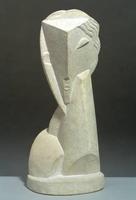
Figura
Henri Laurens
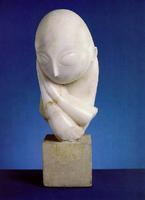
Torso of a Young Girl
Constantin Brâncuși
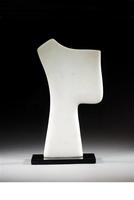
Chantal
Etienne Hajdu
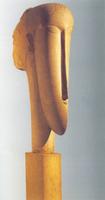
Head
Amedeo Modigliani
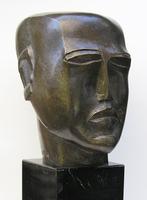
Human head
Ossip Zadkine
No Title
Gustavo Ramos
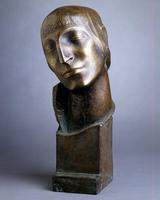
Head of a woman
Stanisław Szukalski
Mask
Olexandr Archipenko
Jacquot
Charles Despiau
Sleeping Muse II
Constantin Brâncuși
Le Sphinge
Anton Prinner
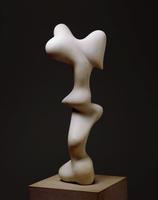
Growth
Jean Arp
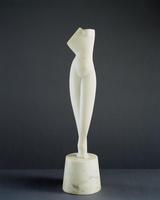
Torso
Olexandr Archipenko