

Expert analysis of Olexandr Archipenko’s Madonna of the Rocks
Style: Cubism · Genre: sculpture
Expert Analysis: "Madonna of the Rocks" by Olexandr Archipenko
Olexandr Archipenko’s Madonna of the Rocks (1914) stands as a landmark in the history of Cubist sculpture, demonstrating how Cubist principles of fragmentation, multiple viewpoints, and geometric abstraction could be translated from painting into three-dimensional form. This work is significant not only for its stylistic innovation but also for its radical reinterpretation of a traditional religious subject—the Madonna and Child—through a modernist lens.
Cubist Sculptural Language
Unlike classical or Renaissance sculptures that emphasize solid, continuous mass, Archipenko hollows out the figure, juxtaposing convex and concave planes to create a sense of rhythm and transparency. The work features angular, faceted surfaces that break down the human form into interlocking geometric shapes—cylinders, cones, and spheres—borrowed directly from Cubist painting (especially the early works of Picasso and Braque). Archipenko goes further by introducing “negative space” as an active compositional element: voids and openings (such as where the Madonna’s body meets the child) become just as important as the solid material, a pioneering concept later termed “sculptural transparency.”
Reinvention of a Sacred Motif
By applying Cubist distortion to the enduring icon of the Madonna, Archipenko challenges Renaissance and Baroque traditions of idealized naturalism. The face of the Madonna is schematic, almost mask-like, with asymmetrical eyes and a flattened nose, while the infant Christ is reduced to a cluster of rounded abstract forms. This abstraction does not erase devotion but reframes it—the work feels both archaic (echoing Byzantine or Romanesque sculptures) and startlingly modern. The title “of the Rocks” may allude to the rugged, unpolished stone-like texture of the bronze (or plaster) surface, as well as to the geological, elemental quality of the composition.
Historical Importance
Created in the same year World War I began, Madonna of the Rocks represents Archipenko’s mature Cubist phase, during which he was determined to prove that sculpture could be as radical as painting. It predates other key Cubist sculptures (e.g., Picasso’s Glass of Absinthe of 1914) and solidified Archipenko’s reputation as the first sculptor to fully embrace Cubist fragmentation. Moreover, the work’s combination of a deeply sacred subject with avant-garde form exemplifies the early 20th-century tension between tradition and rupture—a dialogue that would define modernism.
In sum, Madonna of the Rocks is significant for its pioneering use of concave space in sculpture, its bold reimagining of a religious archetype within Cubist grammar, and its enduring influence on subsequent generations of abstract and Constructivist sculptors.
Visually similar
20 works with related composition and palette

The Boxers (La Lutte)
Olexandr Archipenko

Seated Female Nude (Black Torso)
Olexandr Archipenko
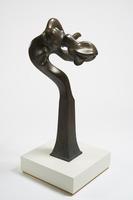
Fish Curve Hybrid
Richard Hunt

Victor
MAUREEN QUIN

L'Aurore
Henri Laurens
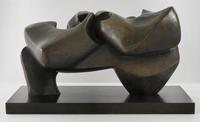
Large Slow Form
Henry Moore

Woman Combing her Hair
Olexandr Archipenko
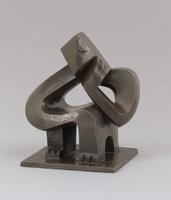
Seated Man
Jacques Lipchitz

Female Figure in Flenite
Jacob Epstein

Le grand adieu
Henri Laurens

Flux (The Runner)
Leon Underwood

Venus
MAUREEN QUIN

Femme allongée
Anton Prinner

Composition
Henry Moore

Hester Rupert Art Museum Sculptures 10
MAUREEN QUIN

Autumn
Henri Laurens

Unique Forms of Continuity in Space
Umberto Boccioni

Untitled
Bahman Mohasses

Dancing Torso
MAUREEN QUIN
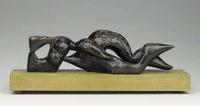
Eventide
Henri Laurens