Analisi esperta di Sorrow di Olexandr Archipenko
Stile: Cubism · Genere: sculpture
Expert Analysis: "Sorrow" by Olexandr Archipenko
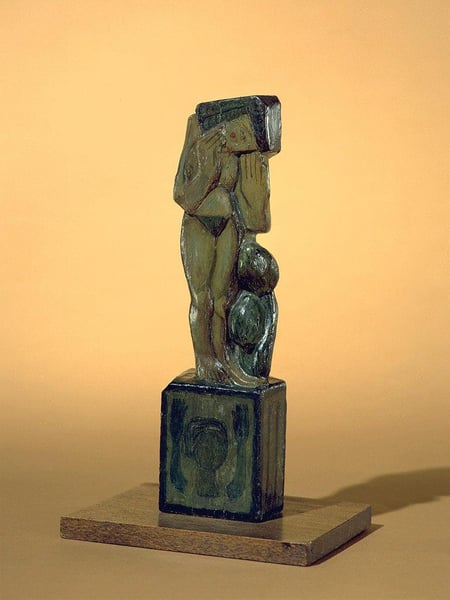
As a seminal work of Cubist sculpture, Olexandr Archipenko’s "Sorrow" stands as a landmark in early 20th-century modernism. Executed within the Cubist idiom, the piece exemplifies the revolutionary translation of two-dimensional Cubist principles—fragmentation, multiple perspectives, and geometric abstraction—into three-dimensional form.
Significance within Cubism and Sculpture
Archipenko was a pioneer in applying Cubist aesthetics to sculpture, and "Sorrow" demonstrates his radical departure from traditional sculptural conventions. Instead of modeling a continuous, organic human figure, Archipenko breaks the form into intersecting planes, concave voids, and sharp angles. This fragmentation allows the viewer to perceive the subject from multiple viewpoints simultaneously, a core Cubist goal. The title "Sorrow" suggests an emotional state, yet the artist conveys grief not through realistic facial expression or classical drapery, but through the tension of abstracted, asymmetrical volumes and the dramatic interplay of light and shadow across faceted surfaces.
Innovative Use of Negative Space
A key significance of this work lies in Archipenko’s pioneering use of negative space—holes and recesses—as active compositional elements. In "Sorrow", the emptiness becomes as expressive as the solid mass, creating a sense of hollowing out or loss that directly embodies the theme of sorrow. This technique, which Archipenko termed "sculpture in space," challenged the traditional notion that sculpture must be a closed, monolithic mass. By integrating voids, he achieved a new kind of transparency and dynamic equilibrium, influencing generations of later sculptors.
Material and Texture
While the specific medium is not detailed, Archipenko typically worked in bronze, plaster, or stone. The angular, Cubist planes would catch light in irregular patterns, emphasizing the emotional dissonance of the piece. The juxtaposition of smooth and rough surfaces (inferred from his general practice) further enhances the sense of psychological turbulence.
Art Historical Legacy
"Sorrow" is significant because it proves that Cubism—often associated with painting—could produce emotionally resonant, spatially complex sculpture. Archipenko’s manipulation of form and void in this work directly anticipates later developments in Constructivism and modernist abstraction, cementing his role as a bridge between analytical Cubism and more expressive, non-representational sculptural language. The piece remains a powerful example of how formal innovation can serve emotional expression, making it a touchstone in the history of modern sculpture.
Visivamente simili
20 opere con composizione e palette affini
Le petit homme
Le Corbusier

Woman
Chaim Gross Lakewood NJ
Woman standing
Ossip Zadkine
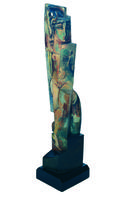
ANDROGENE
Yervand Kochar

Ballerina, passo di danza
Giacomo Manzu

The Diving Boy
Augusta Savage

Woman Combing her Hair
Olexandr Archipenko

L’Adolescente
Charles Despiau
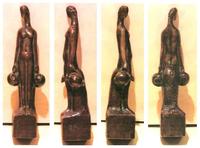
Girl With Jars
Dimitrie Paciurea
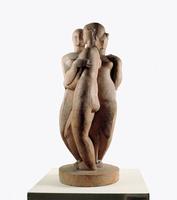
Tres Gracas
Victor Brecheret
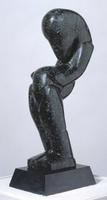
Female Figure in Flenite
Jacob Epstein

Bailarina
Victor Brecheret

The Broken Pot
Anders Zorn
Cuerpo desnudo
Francisco Serra Andrés
Nude
Anton Prinner
Niobe
Antonietta Raphael
Florence Triumphant over Pisa
Giambologna
Seating nude
Pablo Picasso
Figure with Legs Crossed
Manuel Neri

Standing female figure
Olexandr Archipenko