Analisi esperta di The Gondolier di Olexandr Archipenko
Stile: Cubism · Genere: sculpture
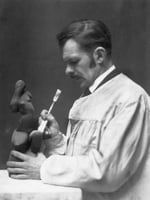
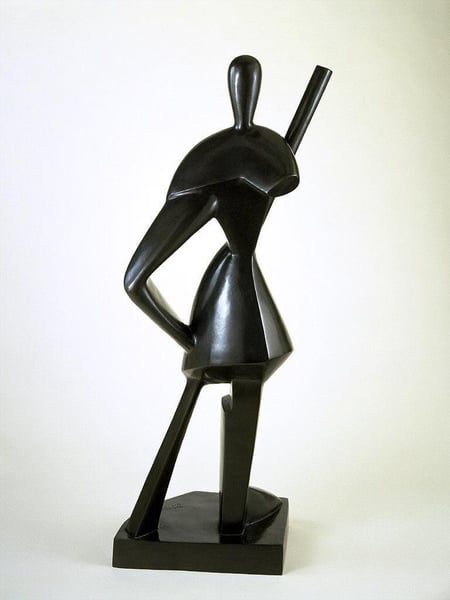
Expert Analysis: "The Gondolier" by Olexandr Archipenko
Olexandr Archipenko’s The Gondolier stands as a landmark achievement in the evolution of Cubist sculpture, marking a radical departure from traditional, solid-mass representation. Executed in the early 20th century, this work exemplifies how Archipenko translated the fragmented, multi-perspectival language of Cubist painting into three dimensions, fundamentally expanding the possibilities of modern sculpture.
Stylistic and Formal Significance
True to the Cubist ethos, The Gondolier rejects naturalistic proportion and single-viewpoint coherence. The figure is broken into intersecting planes and angular, faceted volumes that shift as the viewer moves around the piece. Archipenko’s pioneering use of "negative space" (or “voids”) is critical here: he carves openings through the solid material, allowing space to become an active, sculptural element. This interplay of concave and convex forms creates a dynamic, rhythmic composition that suggests the motion of a gondolier poling his boat—not through literal depiction, but through abstracted, syncopated geometry.
Archipenko’s Contribution to Cubist Sculpture
At a time when Cubism was primarily a two-dimensional movement (Picasso, Braque), Archipenko was among the first to apply its principles to sculpture, challenging the monolithic, inert traditions of Rodin and earlier figurative work. The Gondolier demonstrates his concept of "sculpture in the round" as a series of interlocking, transparent-like facets, anticipating later developments in Constructivism and abstraction. The title itself—referencing a Venetian boatman—anchors the work in recognizable imagery, but the execution utterly subverts any literal reading: the figure is distilled into a machine-like, rhythmic assemblage of planes, echoing the dynamic energy of modern urban life.
Enduring Legacy
This work is significant because it embodies the crucial shift from sculpture as "carved mass" to sculpture as "organized space." By treating space as a tangible, malleable material alongside bronze or stone, Archipenko opened the door for generations of artists—from David Smith to Henry Moore—to explore negative volume, interpenetration, and geometric abstraction. The Gondolier remains a touchstone for how Cubism liberated sculpture from mimesis, allowing form to express motion, rhythm, and multiplicity of perspectives without sacrificing its tangible, physical presence.
Visivamente simili
20 opere con composizione e palette affini
The Boxers (La Lutte)
Olexandr Archipenko
Woman Combing her Hair
Olexandr Archipenko
Carrousel Pierrot
Olexandr Archipenko
King Solomon
Olexandr Archipenko
Le Sphinge
Anton Prinner
Reclining Figure
Henry Moore
Single Man
MAUREEN QUIN
Earth Wader
David Hare
Fish Curve Hybrid
Richard Hunt
03617a
ambrosio paolo
Nude
Anton Prinner
Sc01056a
ambrosio paolo
Mother and Child
Henry Moore
Дискобол
Євген Каменєв
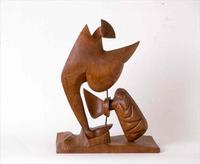
Icône
Le Corbusier
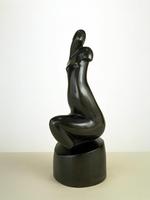
Seated Female Nude (Black Torso)
Olexandr Archipenko
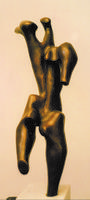
Victor
MAUREEN QUIN
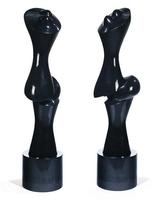
Le grand oiseaux
Agustin Cardenas

Arabian
Olexandr Archipenko
Hester Rupert Art Museum Sculptures 10
MAUREEN QUIN