Expert Analysis: "The Pan Pan at the Monico" by Gino Severini
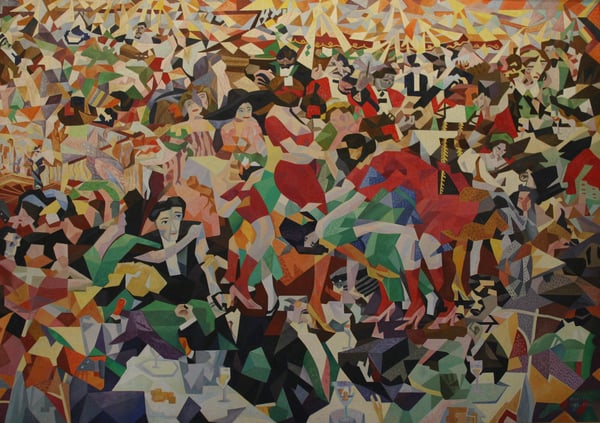
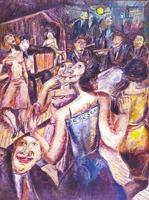
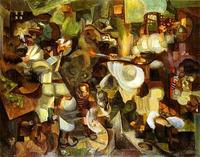
As a quintessential work of Italian Futurism, Gino Severini’s The Pan Pan at the Monico (c. 1909–1911) exemplifies the movement’s radical break from static tradition. Painted in the genre-painting mode—typically reserved for scenes of everyday life—Severini infuses this ordinary Parisian nightclub interior with Futurist dynamism. The work’s significance lies in its synthesis of two seemingly opposed impulses: the intimate, observational realism of genre art and the Futurist obsession with speed, simultaneity, and sensory overload.
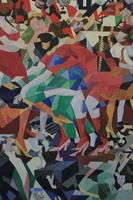
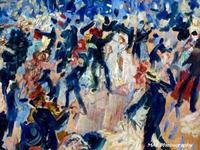
Severini fragments the dancers, musicians, and patrons into interlocking planes of vibrant color and light, capturing the kinetic energy of the “Pan Pan” dance. The composition pulses with diagonal lines and overlapping forms, suggesting multiple viewpoints and moments compressed into a single frame—a visual metaphor for modern urban experience. By applying Futurist principles (e.g., “universal dynamism,” the blur of motion) to a contemporary social ritual, Severini elevates a mundane cabaret scene into a manifesto of modern life. This painting stands as a crucial bridge between the static, anecdotal genre scenes of the 19th century and the fully abstract, energetic experiments of later Futurism, demonstrating how avant-garde techniques could reinvent even the most traditional subjects.