Frank Auerbach sanatçısının Albero di Fronte eseri hakkında uzman analizi
Tarz: Expressionism · Tür: cityscape
Expert Art Historical Analysis: "Albero di Fronte" by Frank Auerbach
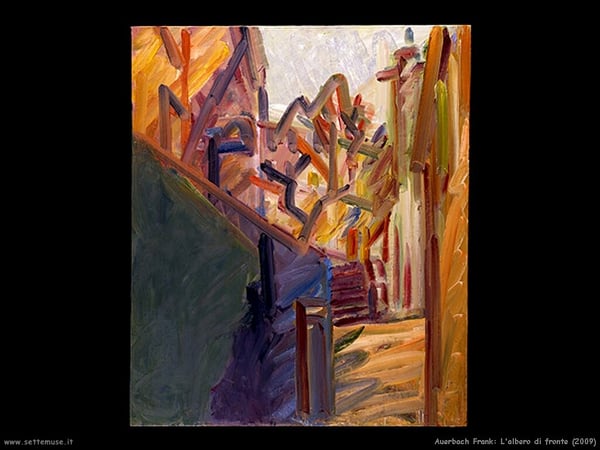
Frank Auerbach’s Albero di Fronte (Italian for "Tree in Front") stands as a compelling example of Expressionist cityscape painting, where the artist’s signature gestural intensity transforms an urban scene into a visceral emotional record. The work’s significance lies in how it bridges the raw physicality of Expressionist technique with the specific, lived experience of a place—a defining characteristic of Auerbach’s oeuvre.
Within the Expressionist tradition, Auerbach here moves beyond mere representation of a city view. The title itself foregrounds a natural element (the tree) against the built environment, creating a dynamic tension that is typical of his approach: the organic, almost sculptural mass of paint used for the tree pushes against the architectural shapes of the cityscape. This interplay embodies the Expressionist goal of conveying inner feeling over outward appearance. The heavy, layered impasto—a hallmark of Auerbach’s method—does not simply depict the scene but seems to excavate it, as if the artist is digging through layers of memory and observation to find the essential energy of the subject.
As a cityscape, Albero di Fronte is significant because it refuses the detached, panoramic view common in urban painting. Instead, it plunges the viewer into a claustrophobic, almost confrontational proximity with the tree and the buildings behind it. This aligns with Auerbach’s broader practice: he often returned to the same London street corners or construction sites for decades, painting them repeatedly to distill their character. Here, the Expressionist distortion—the blurred edges, the agitated brushstrokes, the compressed space—suggests a psychological engagement with the city as a living, chaotic organism. The tree becomes a protagonist, its branches perhaps echoing the angular lines of the architecture, or standing in defiant opposition to them.
In the context of Expressionist cityscapes, Albero di Fronte demonstrates how Auerbach pushed the genre toward a near-abstract corporeality. The paint itself asserts a presence that rivals the subject matter, making the act of painting as important as the scene depicted. This work exemplifies how Expressionist cityscapes can capture not just a location, but the artist’s struggle to perceive and inhabit it, embedding that struggle in every thick, urgent stroke.
Tür
Stil
Görsel olarak benzer
İlişkili kompozisyon ve renk paletine sahip 20 eser
Albero di Fronte
Frank Auerbach
Untitled
Menez
Gurzuf
Volodymyr Loboda
Landscape with Houses
Robert De Niro, Sr.
Acacias
André Lhote
Landscape
Valerii Lamakh
Arcueil
Henri Matisse
Untitled
Pablo Picasso
Methodist Chapel
Frances Hodgkins
To the Studios
Frank Auerbach
Bradford On Tone, Geoffrey Gorer’s Cottage
Frances Hodgkins
Untitled
Minas Avetisyan
Cour
Alekos Kontopoulos
Untitled
Dilek Demirci
Cagnes-sur-Mer
William H. Johnson
Modok Mária, Szentendrei Házak 1930
Modok Mária
Landscape
Michel Kikoine
Landscape with Mill
Albert Gleizes
House in the garden
August Macke
Lisbon (Portugal christmas card to Harold Weston)
Carlos Botelho