
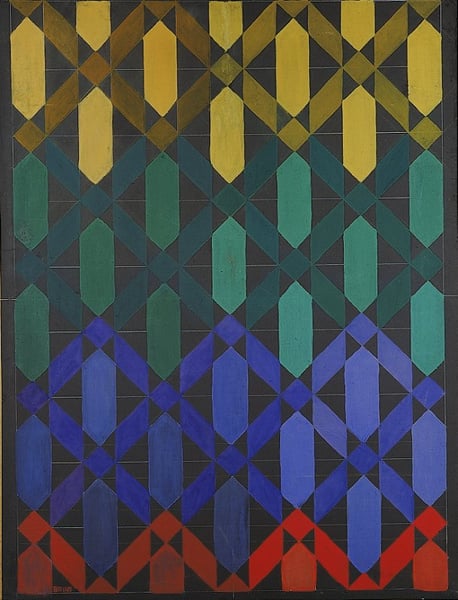
Iridescent Interpenetration No.13
Details
Expertenanalyse zu Giacomo Ballas Iridescent Interpenetration No.13
Stil: Abstract Art · Genre: abstract
Expert Analysis: "Iridescent Interpenetration No.13" by Giacomo Balla
Giacomo Balla’s Iridescent Interpenetration No.13 marks a pivotal moment in the evolution of abstract art, bridging the dynamism of Futurism with a pure, non-objective exploration of color and light. While Balla is best known for his Futurist works that captured movement and speed (e.g., Dynamism of a Dog on a Leash), this series—and particularly this painting—demonstrates his radical departure from figuration toward a self-referential visual language.
Significance within Abstract Art
The work is a masterful study of optical vibration, achieved through overlapping, translucent planes of intense, iridescent hues. Balla systematically arranges geometric shapes—triangles, arcs, and rhomboids—that seem to pulse and interpenetrate, dissolving the boundary between form and background. This approach anticipates later developments in Op Art and Color Field painting, yet remains deeply rooted in the Futurist obsession with energy and simultaneity. The title itself, Iridescent Interpenetration, highlights two key innovations: the illusion of light refracting like a prism (iridescence) and the spatial complexity of forms that merge and separate simultaneously.
Composition and Technique
Balla employs a carefully calibrated palette of complementary colors—vibrant oranges, blues, pinks, and greens—that generate afterimages and retinal flicker. The shapes are not static; they appear to rotate and expand outward, creating a sense of kinetic tension without depicting literal motion. This is abstraction at its most rigorous: the painting’s subject is the very act of seeing, the interplay of wave and particle, light and matter. Every element is non-representational, yet the composition feels organic, as if derived from natural phenomena like sunlight filtering through water or crystalline structures.
Historical Context and Legacy
Created in the early 1910s, Iridescent Interpenetration No.13 belongs to a series that Balla pursued after 1912, following his exposure to the chromatic theories of the Neo-Impressionists and the spiritual abstractions of Wassily Kandinsky. It stands as a bold rejection of traditional perspective and narrative, aligning Balla with the international avant-garde that sought to express the inner life of the modern world through color and form alone. In its systematic decomposition of pictorial space, the work not only anticipates later geometric abstraction but also serves as a crucial link between Italian Futurism and the broader abstract movements of the 20th century.
Conclusion
Iridescent Interpenetration No.13 is significant because it crystallizes Balla’s shift from depicting motion to generating a purely optical experience of movement through color and shape. It is a testament to abstraction’s power to evoke the sublime—the shimmering, ever-shifting essence of reality—without recourse to the visible world. This painting remains a cornerstone of early European abstraction, demonstrating that the most radical art often arises when artists push their own stylistic boundaries to their logical, visionary extremes.
Visuell ähnlich
20 Werke mit ähnlicher Komposition und Farbpalette
No. 260
Hans Hinterreiter
Studie H.H.305
Hans Hinterreiter
No. 258
Hans Hinterreiter
238 combinazioni cromatiche con 16 colori moltiplicati fra loro
Dadamaino
Untitled
Max Bill
Systole And Diastole
Alfred Jensen
Bees
Henri Matisse
Opus 46
Hans Hinterreiter
French Painting
Pat Lipsky
Second Movement V
Anni Albers
Untitled
Ruth Vollmer
Big Bang Series
Larry Zox
Estrutura Ambígua IV
Eduardo Nery
Sem Título
Manuel Cargaleiro
Hommage à Terry Riley
Charles Bezie
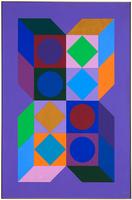
Sonora Do
Victor Vasarely
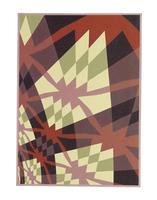
Opus 5
Hans Hinterreiter
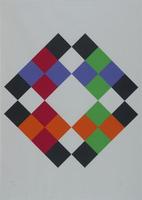
Untitled
Max Bill

Trasposizione grafica
Paolo Scheggi
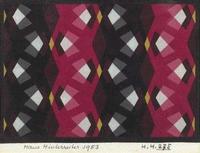
Untitled Composition 275
Hans Hinterreiter