Expert Analysis: "Sunset of the Prairies" by Albert Bierstadt
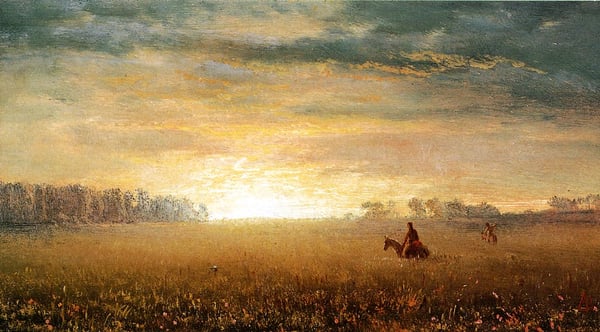
As a hallmark of the Luminist movement, Albert Bierstadt’s Sunset of the Prairies exemplifies the style’s central preoccupation with the transformative power of light. The painting captures the vast, unspoiled American prairie at the moment of sunset, where the sky becomes a symphony of warm, glowing tones—golds, pinks, and deep oranges—that reflect off the low-lying clouds and spread softly across the endless horizon. Bierstadt’s meticulous attention to atmospheric effect, a defining trait of Luminism, creates a serene, almost spiritual stillness. The landscape is rendered with precise, nearly imperceptible brushwork, allowing the light to appear as a natural, transparent veil that unifies land and sky.
The significance of this work lies in its embodiment of Luminism’s ideals: the celebration of an idyllic, untouched nature, the use of light to evoke a sense of sublime transcendence, and the quiet reverence for the American frontier. Bierstadt elevates the prairie—often seen as monotonous—into a domain of luminous grandeur, reinforcing the 19th-century belief in the divine beauty of the expanding nation. Unlike the dramatic, heroic scale of his Western mountain scenes, here the power is in the subtlety of the fading daylight, marking Sunset of the Prairies as a masterful meditation on light's fleeting, unifying presence.