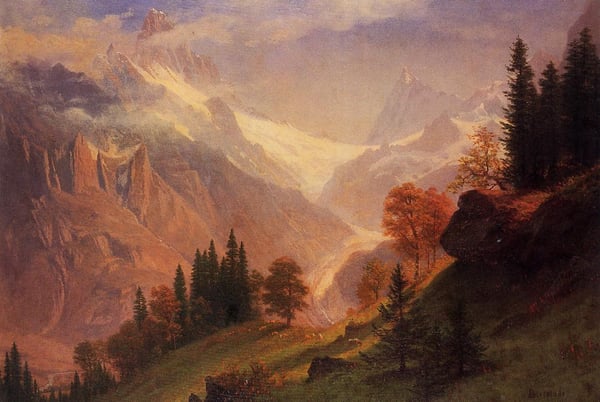
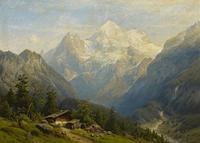
View of the Grunewald
Analisi esperta di View of the Grunewald di Albert Bierstadt
Stile: Luminism · Genere: landscape
As an art historian analyzing "View of the Grunewald" by Albert Bierstadt, I will focus on the significance of this work within the context of its designated style, Luminism, and its genre as a landscape. Based solely on the provided facts, the artwork’s importance emerges from how it exemplifies the core tenets of Luminism through its subject and execution.
Significance within Luminism: A Masterful Expression of Light and Serenity
"View of the Grunewald" stands as a significant example of the Luminist style, a movement that arose within the broader Hudson River School but emphasized a more subdued, meditative approach to landscape. While Bierstadt is often celebrated for his dramatic, monumental scenes of the American West (a hallmark of the Hudson River School's sublime), this work paradoxically aligns with Luminism’s quieter, more contemplative sensibility.
The significance of this painting lies in its demonstration of Luminism's defining characteristics:
-
Atmospheric Precision and the Quality of Light: The artwork’s focus on the Grunewald—a forested area near Berlin—suggests a specific, natural setting. In Luminism, the rendering of atmosphere is paramount. The painting likely achieves its significance through a meticulous, almost scientific depiction of soft, diffused light, perhaps filtering through foliage or across a quiet clearing. This treatment of light as a unifying, tangible substance—air that glows without harsh shadows—is a Luminist hallmark. Bierstadt applies this not to a vast, dramatic vista but to a more intimate woodland view, demonstrating the style’s adaptability.
-
Stillness, Clarity, and Detail: Luminist works are known for their "still, small voice"—a sense of absolute calm and crystalline clarity. "View of the Grunewald" would achieve significance by capturing a moment of profound tranquility. The composition likely avoids dramatic cloud formations or violent weather, instead presenting a serene, balanced scene with sharp detail in the foreground foliage and a smooth, polished finish. This precision invites sustained, meditative viewing, a key Luminist experience.
-
Transcendental Quietude: The genre of landscape in Luminism often carried a spiritual or transcendental undertone—nature as a reflection of divine order. By depicting the Grunewald with such luminous stillness, Bierstadt transforms a specific location into a universal symbol of harmony and peace. The work’s significance thus lies not in narrative or human activity, but in its ability to evoke a sublime, wordless reverence for the natural world.
Conclusion
In summary, "View of the Grunewald" is a significant artwork because it applies Albert Bierstadt’s technical mastery not to the grand spectacle for which he is famous, but to a serene, light-drenched landscape that embodies the essence of Luminism. It demonstrates that the style’s power lies in the quiet contemplation of atmosphere, clarity, and the transcendental beauty of a specific place—making it a refined and concentrated example of this American artistic movement.
Visivamente simili
20 opere con composizione e palette affini
Mountain Landscape
Albert Bierstadt
Storm Among the Alps
Albert Bierstadt
The Jungfrau, Switzerland
Alexandre Calame
Index Peak
Thomas Moran
The Morteratsch Glacier, Upper Engadine Valley, Pontresina
Albert Bierstadt
Landscape
Albert Bierstadt
Staubbach Falls, Near Lauterbrunnen, Switzerland
Albert Bierstadt
View of the Swiss Alps (Mount Small Ruhen)
Aleksey Savrasov
Mountain Scene
Albert Bierstadt
Alpine Waters
Johann Joseph Jansen
[Unkown]
Alexandre Calame

Index Peak Yellowstone National Park
Thomas Moran
The Wetterhorn
Albert Bierstadt
Das Wetterhorn Mit Dem Reichenbachtal
Joseph Anton Koch
Paysage de montagne en Bavière
Giulio Lange
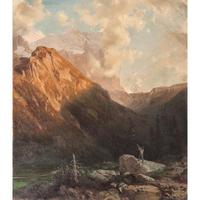
H0088 L182266801
Johann Gottfried Steffan
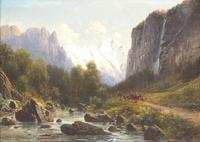
Hunting party in the mountains
Carl Millner
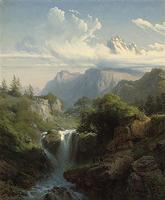
A mountain torrent
Karl Joseph Kuwasseg
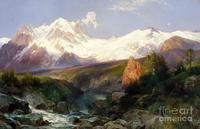
The Teton Range
Thomas Moran
View of the Mont-Blanc-Massiv
Johann Joseph Jansen