Expert analysis of Albert Bloch’s The house next door
Style: Expressionism · Genre: landscape
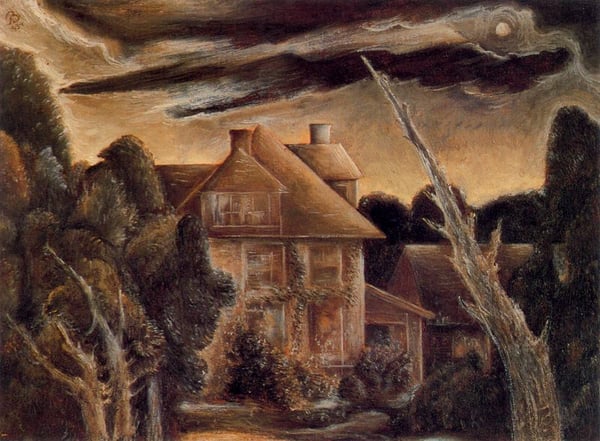
Expert Analysis: "The house next door" by Albert Bloch
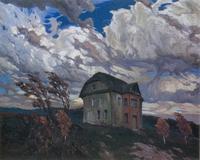
Albert Bloch’s The house next door stands as a compelling example of Expressionist landscape painting, distinguished not only by its stylistic intensity but also by the artist’s unique historical position as the only American member of the German avant-garde group Der Blaue Reiter (The Blue Rider). This work, though rooted in the familiar genre of landscape, transcends mere depiction to become a psychological and emotional projection—a hallmark of Expressionism.
Significance within Expressionism
- Expressive Distortion and Color: Bloch employs the quintessential Expressionist tactics of distorted perspective and heightened, non-naturalistic color. The house, likely a modest vernacular structure, is rendered with angular, almost claustrophobic lines, while the sky and ground are saturated with jarring hues (perhaps deep blues, greens, or fiery oranges) that convey a sense of unease or spiritual tension. This is not a documentary landscape but a reflection of the artist’s inner state—the “house next door” becomes a symbol of the uncanny, the familiar turned strange.
- Emotional Intensity: Following the ethos of Der Blaue Reiter, Bloch sought to evoke the “inner necessity” of art. The painting’s power lies in its ability to transform a mundane suburban subject into a charged vision, where the house appears both solid and dissolving, real and dreamlike. This aligns with the movement’s emphasis on the spiritual and the subjective over objective representation.
Bloch’s Unique Position
- American in the Blue Rider: Bloch’s participation in the 1911 and 1912 Der Blaue Reiter exhibitions (alongside Kandinsky, Marc, and Macke) places him at the forefront of early European Modernism. The house next door likely reflects his synthesis of German expressionist grammar—fauvist-inspired color, primitivist simplification, and a touch of cubist faceting—with an American vernacular sensibility. While his European peers often painted apocalyptic or cosmic landscapes, Bloch turned his eye to the ordinary, domestic American scene, infusing it with the same existential weight.
- Late Career and Legacy: Bloch left Europe at the outbreak of World War I and eventually settled in Kansas, where he continued to paint in an increasingly personal, symbolic style. This work, probably from his later American period, shows him adapting Expressionist techniques to the flat, sun-drenched spaces of the Midwest. It is a significant testament to how German Expressionism traveled and mutated in non-European contexts, predating the more famous transfer of European modernists to the U.S. in the 1930s.
In summary, The house next door is significant because it bridges two worlds—the radical spiritualism of Der Blaue Reiter and the quiet, unsettling terrain of the American familiar. Bloch transforms a simple landscape into a site of psychological inquiry, proving that Expressionist intensity can be found not just in the cathedral or the mountain, but in the house next door.
Visually similar
20 works with related composition and palette
Sally and Paul, Reds and Greens
John French Sloan
Cottage of the Artist in Kilo
Magnus Enckell
Cape Cod Afternoon
Edward Hopper
Cape Cod Afternoon
Edward Hopper
The Lime Kiln
John Crome
The Blood Family Homestead
Fitz Hugh Lane
Julia on the Swing
Jamie Wyeth

Easthampton
Thomas Moran
McGee's
Jamie Wyeth
Edge of the Forest
Ralph Blakelock
Our Red Cottage, Gloucester
John French Sloan
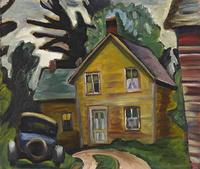
Farmhouse and Car
Prudence Heward
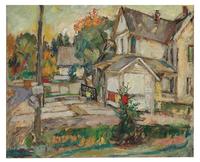
Street Scene with Hot Dog Stand
Abraham Manievich
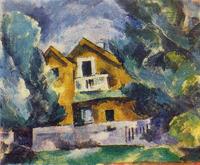
Kuntsevo. Cottage.
Pyotr Konchalovsky
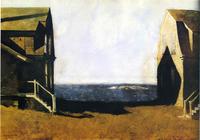
Summer House, Winter House
Jamie Wyeth
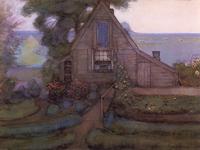
Triangulated Farmhouse Facade with Polder in Blue
Piet Mondrian
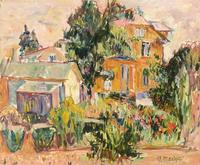
The Yellow House
Abraham Manievich
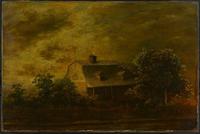
Farmhouse of F.B. Guest
Ralph Blakelock
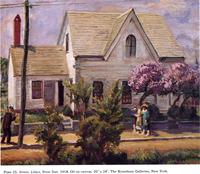
Street, Lilacs, Noon Sun
John French Sloan
Pustka - Stare gniazdo
Ferdynand Ruszczyc