Expert analysis of Umberto Boccioni’s Cloister of S. Onofrio
Style: Divisionism · Genre: cityscape
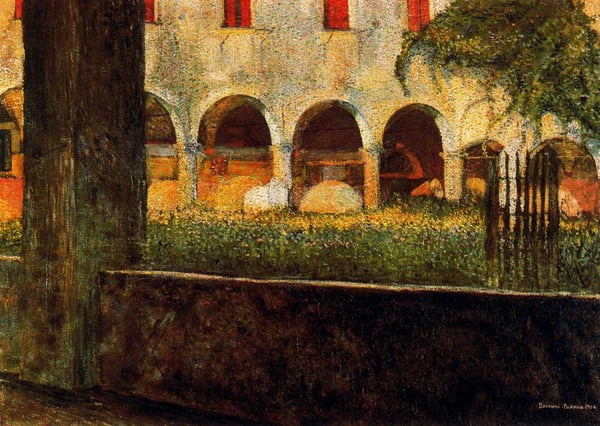
Umberto Boccioni’s Cloister of S. Onofrio is a significant early work that demonstrates his mastery of Divisionism before he became a leading figure of Futurism. Executed in the Divisionist style, the painting applies the technique of separating color into distinct strokes or dots, which was derived from Neo-Impressionism. As a cityscape, it depicts a specific architectural space—the cloister of the Church of S. Onofrio—but transforms the brick-and-stone structure into a shimmering study of light and atmosphere.
The artwork’s importance lies in how Boccioni uses Divisionist methods to capture the vibrancy of an urban (or ecclesiastical) environment. The individual touches of pure pigment create a luminous, almost vibrating surface that anticipates the Futurist obsession with movement and sensory dynamism. Here, the cloister’s arches and columns are rendered not as static masses, but as patterns of interacting color, demonstrating Boccioni’s departure from traditional perspective in favor of a more optical, modern experience. Cloister of S. Onofrio thus marks a crucial step in his evolution from a trained Divisionist to a pioneer of the avant-garde, showing how he repurposed a scientific color theory to infuse a seemingly quiet subject with a new kind of energetic pictorial life.
Visually similar
20 works with related composition and palette
Cottage
Angelo Morbelli
Cloister interior
Vincenzo Cabianca
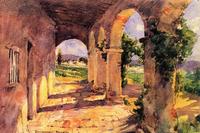
Corridors of San Juan Capistrano
Benjamin Brown
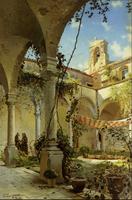
The Cloister, Taormina
Peder Monsted
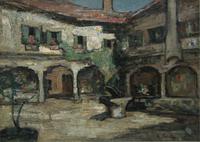
Cortile D'Abazza - Venice
Gheorghe Petrascu
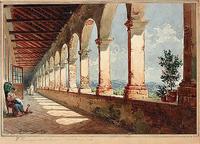
afternoon pursuits of a lady
Luigi Premazzi
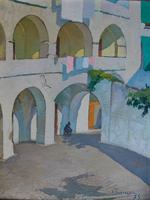
Anfiteatro Square in Formia
Antonio Sicurezza
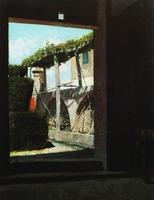
View from the Cellar of Diego Martelli
Giuseppe Abbati
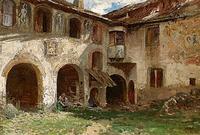
In the court of the Fürstenburg near Burgeis
Robert Russ
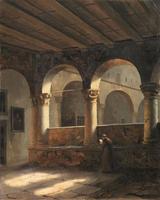
Glimpse of the monastery of Florence
Vincenzo Abbati
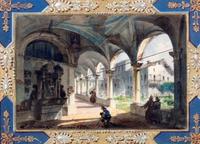
Devotion in the cloister
Luigi Premazzi
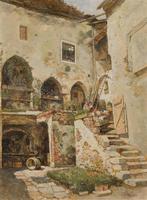
Teisenhoferhof in Weißenkirchen
Paul Unbereit
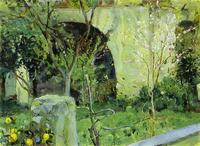
Capri. Almond trees in blossom.
Mikhail Nesterov
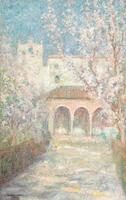
Patio la Sevilla
Samuel Mutzner
Garden of Lindaraja
Joaquín Sorolla
A Roman alley
Ernst Meyer
Portico of the Colma
Angelo Morbelli
Estela
José Garnelo
The Monastery of San Lorenzo Fuori le Mura (school of Eckersberg)
Christoffer Wilhelm Eckersberg
A Venice courtyard
Federico del Campo