Expert analysis of Umberto Boccioni’s Nocturne
Style: Cubism · Genre: symbolic painting
Expert Analysis of "Nocturne" by Umberto Boccioni
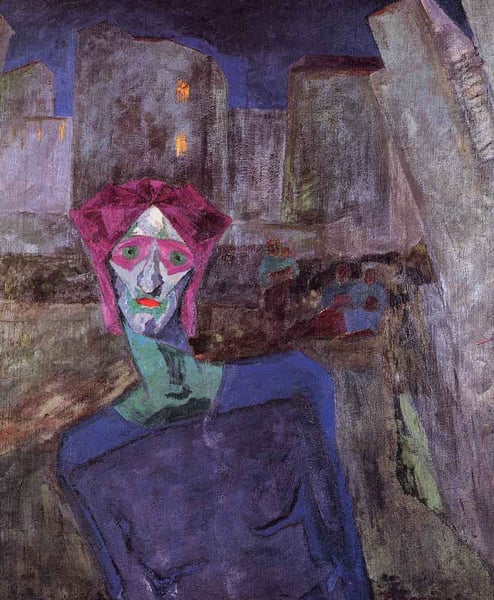
Umberto Boccioni’s Nocturne stands as a compelling—and arguably transgressive—intersection between Cubist formal language and Futurist sensibility, filtered through a deeply symbolic pictorial intention. While Boccioni is canonically celebrated as a leading theorist and painter of Italian Futurism, the assignment of Nocturne to the Cubist style highlights how the artist absorbed and reoriented the analytical space-fracturing techniques of Picasso and Braque for a different emotional and symbolic purpose.
Significance within Cubism:
Though Cubism is often associated with still life, portraiture, and the dissection of everyday objects from multiple viewpoints, Boccioni’s Nocturne demonstrates Cubism’s capacity to handle nocturnal, symbolic, and psychologically charged themes. The work likely employs Cubism’s trademark fragmentation and faceted planes not to analyze a static object, but to capture the elusive, shifting quality of night itself—its lights, shadows, and enigmatic atmosphere. By applying Cubist structure to a subject that is inherently fleeting and subjective, Boccioni extends the movement’s vocabulary beyond the visual to the conceptual. The painting thus bridges the analytic rigor of Cubism with the Futurist obsession with dynamism and modern sensation, even as it remains stylistically Cubist in its construction.
Significance as Symbolic Painting:
In the genre of symbolic painting, Nocturne resonates with fin-de-siècle Symbolism’s interest in mystery, the subconscious, and the spiritual dimensions of modernity. Boccioni uses the Cubist grid not as a neutral organizational device, but as a symbolic screen through which the night is experienced as a labyrinth of fractured consciousness. The “nocturne” itself—a musical term for a night-piece—suggests a mood of quiet contemplation or uneasy tension. By rendering this mood in a Cubist idiom, Boccioni anticipates later developments in which abstraction serves emotional expression rather than mere perception. This work is significant because it demonstrates that Cubism could be a vehicle for symbolic content, not just formal experiment.
Ultimately, Nocturne is a rare and significant example of a Futurist artist consciously adopting Cubist methods to articulate a symbolic vision of modern night—a moment of stillness and introspection in an oeuvre otherwise known for speed, noise, and violent motion. It enriches our understanding of how Cubism traveled beyond Paris and was reinvented for new expressive and philosophical ends.
Visually similar
20 works with related composition and palette
Modok Mária, Fekete Blúzos Nő
Modok Mária
Prophets (Double Self Portrait)
Egon Schiele
Procession
Egon Schiele
Armut
Lasar Segall
Kondor Béla, Piros Hajú Nő
Kondor Béla
Self Portrait with Bouquet
Marc Chagall
White sound
Wassily Kandinsky
Portrait of a Young Girl
Amedeo Modigliani
Jeanne Hebuterne in a Yellow Jumper
Amedeo Modigliani
Easter Monday
Willem de Kooning
Sun and Moon
Theophilus Brown
American Scene
Jacqueline Hick
Young Woman
Amedeo Modigliani
A Head
Amedeo Modigliani
Nude with Red Turban
Bela Czobel
Friends
Helene Schjerfbeck
A young girl
Amedeo Modigliani
Portrait of a Young Girl (Louise)
Amedeo Modigliani
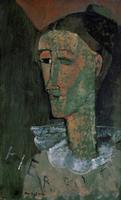
Pierrot (Self Portrait as Pierrot)
Amedeo Modigliani
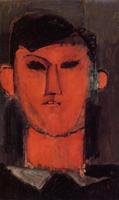
Portrait of Picasso
Amedeo Modigliani