Analisi esperta di Self-portrait di Umberto Boccioni
Stile: Pointillism · Genere: self-portrait
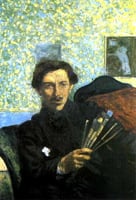
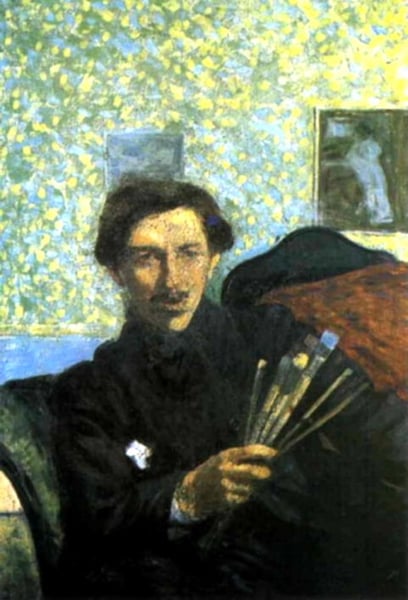
This self-portrait by Umberto Boccioni is a fascinating testament to his early mastery of Pointillism, a style he adopted before becoming a leading voice of Futurism. Executed in the genre of self-portraiture, the work is significant for several reasons:
-
Technical precision within Pointillism: Boccioni applies the rigorous dot-and-dash technique with remarkable control. The careful placement of pure, unblended pigments—warm ochres, cool blues, and vibrant greens—creates a luminous, almost vibrating surface. This optical mixing not only models the face with volume and shadow but also injects a sense of inner restlessness, a psychological intensity rare in the typically detached, landscape-focused Pointillism of Seurat.
-
Bridging Divisionism and Futurism: Though strictly Pointillist in method, the painting already hints at Boccioni’s future Futurist preoccupations. The fragmented, shimmering brushwork imbues the static self-portrait with a subtle dynamism—the face seems to flicker between states of concentration and anxiety. This early work proves that Boccioni used Pointillism not as an end in itself, but as a tool to express modern, subjective experience, foreshadowing the movement and emotional charge he would later champion.
-
Psychological depth through color theory: Unlike many Pointillist portraits that emphasize optical experiment over sitter psychology, Boccioni’s self-portrait uses color to articulate mood. The contrast between the cool, pale flesh tones and the dark, brooding background (built from deep blues and violets) isolates the figure and suggests introspection. The scattered, almost nervous application of dots around the eyes and mouth creates a sense of shifting expression, capturing the artist’s own self-scrutiny.
In short, this work is significant because it demonstrates how Boccioni transformed Pointillism from a purely scientific system of color into a means of conveying psychological tension and pre-modernist energy—a crucial step on his path to becoming the theorist and practitioner of Futurist dynamism.
Museum / Gallery
Visivamente simili
20 opere con composizione e palette affini
Self-Portrait with an Easel
Gustave Caillebotte
Self Portrait
Boris Kustodiev
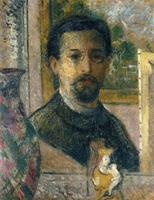
Self-Portrait with Statuette
Gustave Loiseau
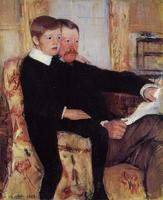
Portrait of Alexander J. Cassat and His Son Robert Kelso Cassatt
Mary Cassatt
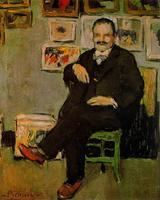
Portrait of Gustave Coquiot
Pablo Picasso
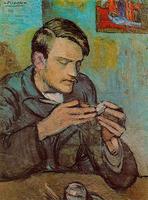
Portrait of Mateu Fernandez de Soto
Pablo Picasso
Portrait of An Armenian Artist V. Akhikyan
Fedir Krychevsky
Portrait of Pinchus Kremenge
Amedeo Modigliani
Portrait of Francis Edward James
Philip Wilson Steer
Seated Woman Dressed in Black
Edouard Vuillard
Portrait of Rodo Pissarro Reading
Camille Pissarro
Duchesse de Montejasi-Cicerale
Edgar Degas
Čtenář Dostojevského
Emil Filla
Self Portrait
Paul Gauguin
Paul, Study
Camille Pissarro
Portrait of Alexander J. Cassatt
Mary Cassatt
Woman in Profile
Alfred William Finch
Pagan and Degas' Father
Edgar Degas
Portrait of a seated man
Richard Gerstl
Man reading (Father)
Walter Gramatté