Analisi esperta di Astolf rides away with his head lost di Arnold Böcklin
Stile: Symbolism · Genere: literary painting
Artwork: Astolf rides away with his head lost
Artist: Arnold Böcklin
Style: Symbolism
Genre: Literary painting
Expert Analysis:
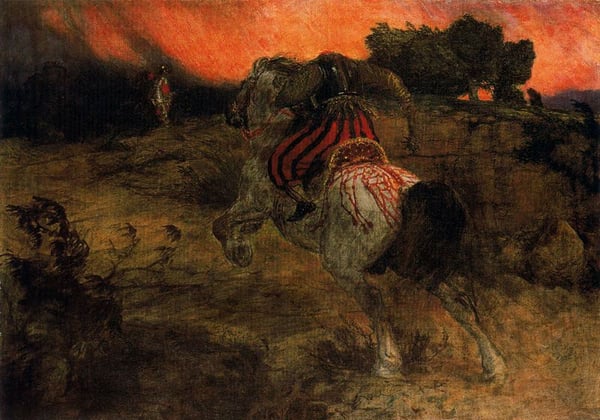
Arnold Böcklin’s Astolf rides away with his head lost epitomizes the Symbolist impulse to transform literary narrative into an enigmatic, psychologically charged image. The title derives from Ludovico Ariosto’s Renaissance epic Orlando Furioso, in which the knight Astolfo (or Astolf) undertakes a fantastical lunar journey to recover the wits (not the literal head) of the mad hero Orlando. Böcklin’s deliberate alteration – substituting “head” for “wits” – is the key to the work’s Symbolist significance: it literalizes the metaphor of lost reason, turning an abstract loss of sanity into a macabre, almost surreal visual event.
Within the Symbolist movement, Böcklin was a master of dreamlike, often eerie tableaux that evoke hidden psychological states. Here, the absence of a clear, rational narrative – we see a rider fleeing with his own severed head, yet he continues to ride – creates a deliberate disjunction between action and consequence. This tension reflects Symbolism’s core interest in the irrational, the uncanny, and the subjective experience of reality. The painting’s literary source is not merely illustrated but subverted: Böcklin reimagines Ariosto’s allegory of folly as a haunting, tangible image of self-alienation.
The work’s significance lies in how it bridges mythological storytelling with modern anxieties about identity and consciousness. The head – the seat of thought, reason, and self – is both lost and carried away, suggesting a profound split between the self that acts and the self that is lost. This duality is a hallmark of Symbolist art, where outward scenes become vehicles for inner, often troubling, psychic landscapes. By choosing a moment that defies easy interpretation, Böcklin ensures the painting lingers as a philosophical riddle, characteristic of the movement’s resistance to didactic meaning.
In the context of Symbolism and literary painting, Astolf rides away with his head lost stands as a seminal example of how visual art can amplify and transform the ambiguities of text, making the invisible – a lost mind, a fragmented self – disturbingly visible.
Museum / Gallery
Visivamente simili
20 opere con composizione e palette affini
Fallen horse
Giorgio de Chirico
Moroccan Horseman Crossing a Ford
Eugene Delacroix
Roland at Roncesvalles
Odilon Redon
Combat Between the Giaour and the Pasha
Eugene Delacroix
The horse has gone
Giorgio de Chirico
The Green Horseman
Odilon Redon
Attila the Hun
Eugene Delacroix
Battle of the Scythians with the Slavs (sketch)
Viktor Vasnetsov
Bolesław the Brave Entering Kyiv
Piotr Michałowski
Reiter
Piotr Michałowski
Santiago en la batalla de Clavijo
Juan Carreno de Miranda
A Turk Surrenders to a Greek Horseman
Eugene Delacroix
Scene of War in the Middle Ages
Edgar Degas
Moroccan Fantasia
Eugene Delacroix
Saint George Fighting the Dragon, Perseus Delivering Andromeda
Eugene Delacroix
Horse with rider
Giorgio de Chirico
Battle of Villaviciosa 1710
Jean Alaux
The battle of Issus(fragment)
Albrecht Altdorfer
The Horse of Mustapha Pasha
Antoine-Jean Gros
Tiger Hunt
Eugene Delacroix