
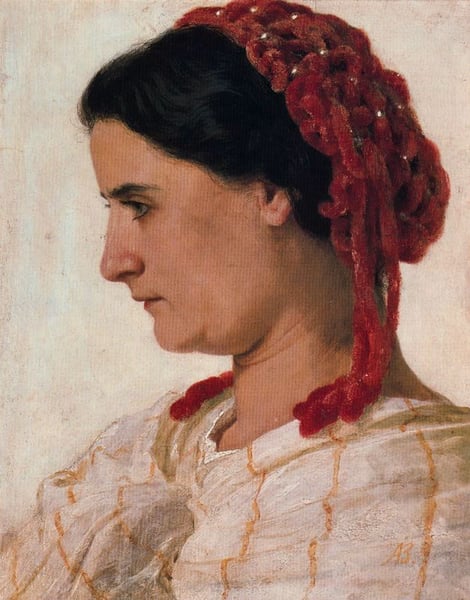
Portrait of Angela Böcklin in red fishnet
Expertenanalyse zu Arnold Böcklins Portrait of Angela Böcklin in red fishnet
Stil: Romanticism · Genre: portrait
This portrait by Arnold Böcklin, a leading figure of German Symbolism often associated with the late Romantic movement, offers a fascinating intersection of intimate realism and Romantic idealism. While the supplied facts classify it strictly under Romanticism and the portrait genre, the work's true significance lies in how it subverts traditional portraiture through its bold, symbolic use of color and texture.
Artistic and Stylistic Significance:
-
Intimacy Over Formality: Unlike the grand, allegorical or mythological subjects for which Böcklin is famous (e.g., Isle of the Dead), this portrait focuses on a specific, real person—Angela Böcklin, likely the artist's wife or daughter. This personal focus aligns with Romanticism's celebration of the individual and the artist's own emotional world over objective, idealized representation.
-
The "Red Fishnet" as a Romantic Gesture: The most striking element is the titular "red fishnet." In a conventional portrait of the era, such an accessory could be seen as trivial or merely decorative. However, within the Romantic framework, it becomes a powerful signifier of:
- Emotional Intensity: Red is the color of passion, vitality, and danger. Against the likely darker or more muted tones of the rest of the composition (a typical Romantic palette), this red fishnet acts as a visual and emotional anchor, suggesting a fiery or untamed personality.
- Symbolic Ambiguity: A fishnet can connote entanglement, entrapment, or even the trapping of a soul—a common Romantic trope exploring the tension between inner freedom and external constraint.
- Sublime Texture: Romantics valued the picturesque and the sublime—qualities that evoke a powerful sensory response. The fishnet’s repetitive, geometric pattern creates a tactile contrast with the soft flesh of Angela’s skin, drawing the viewer into a close, almost voyeuristic relationship with the sitter. This focus on texture and materiality is a hallmark of Böcklin’s unique blend of meticulous detail and dreamlike atmosphere.
-
Bridging the Domestic and the Mythic: While the genre is a simple portrait, the red fishnet elevates the sitter from a mere family member into a quasi-mythological figure. She is simultaneously a real woman and an emblem of Romantic mystery. This duality is crucial: Böcklin takes a private, domestic subject and imbues it with the same symbolic weight he gave to his mythological scenes.
Conclusion:
This portrait is significant because it demonstrates how a later Romantic artist like Böcklin could inject deeply personal, symbolic elements into a seemingly straightforward commission. The "red fishnet" is not an accessory; it is the fulcrum of the composition, transforming a family likeness into a meditation on femininity, passion, and the enigmatic nature of the individual. It stands as a testament to Romanticism’s enduring power to find the extraordinary in the ordinary, and the profound in the personal.
Visuell ähnlich
20 Werke mit ähnlicher Komposition und Farbpalette

Italian three-quarter
Anton Romako

Luisella
Vincenzo Caprile

Portrait of a Young Girl Crocheting
William-Adolphe Bouguereau

Portrait of a young maiden
Henry Mosler

The Greek Girl (Mlle. Dobigny)
Camille Corot

A portrait of a Italian girl
Ludwig Knaus

Reading
Giovanni Costa

Marie in Profile
Peder Severin Kroyer

The Knitter
William-Adolphe Bouguereau

Portrait of a neapolitan woman
Vincenzo Caprile

Italian woman
Vladimir Makovsky

Maiden of the Harvest
Jean-François Portaels

Painting from Life
Richard Jack

Portrait d'une jeune italienne
Jules Salles

Hanging clothes
Luigi Da Rios
Portrait of a woman
Giacomo Favretto

Bust of a peasant woman
Silvestro Lega

A Girl with Kokoshnik (Woman's Headdress in Old Russia)
Mikhail Nesterov

Young Italian Woman in a Folk Costume, Study
Nikolai Ge

Young peasant woman
Noè Bordignon