
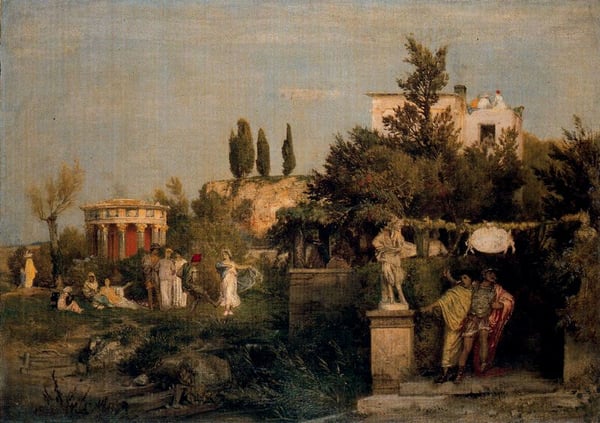
Analisi esperta di Tavern in ancient Rome di Arnold Böcklin
Stile: Romanticism · Genere: landscape
This analysis is based solely on the provided facts: Arnold Böcklin’s Tavern in Ancient Rome, a Romantic landscape.
Expert Analysis
Arnold Böcklin’s Tavern in Ancient Rome is a significant work within the Romantic movement because it exemplifies the period’s fascination with the past as a source of emotional and atmospheric depth, rather than mere historical accuracy. As a landscape, the painting transforms a genre often associated with serene nature into a stage for human drama and antiquity’s allure.
Significance within Romanticism:
- Emotional Evocation: The tavern scene is not a dry archaeological reconstruction; it is imbued with a moody, almost theatrical quality. Romantic landscapes prioritize subjective feeling over objective description, and Böcklin’s use of light, shadow, and ruinous architecture likely creates a sense of nostalgia, decay, or the sublime—key Romantic concerns.
- The Past as Living Presence: Unlike Neoclassical painters who idealized ancient Rome as a model of order, Böcklin treats it as a lived-in, slightly gritty environment. The tavern setting suggests everyday life, making history feel tangible and accessible, a hallmark of Romantic historicism.
- Symbolic Potential: The tavern itself—a place of gathering, wine, and storytelling—could symbolize transience, escapism, or the intersection of classical civilization with mortal pleasures. This aligns with Romanticism’s interest in the fleeting and the human condition.
Within Landscape Genre:
- Narrative Landscape: Böcklin elevates landscape beyond background scenery. The composition likely integrates figures and architecture into the natural or built environment, creating a symbiotic relationship where the setting tells as much of a story as the characters. This anticipates later Symbolist tendencies.
- Contrast with Idyllic Tradition: Unlike the pastoral landscapes of earlier Romantics (e.g., Caspar David Friedrich’s solitary figures against vast nature), Böcklin’s tavern focuses on communal space, suggesting that in a Romantic context, even a humble inn can carry the weight of history and emotion.
In sum, Tavern in Ancient Rome is significant for its ability to fuse historical imagination with Romantic mood, making the landscape itself a conduit for the viewer’s contemplation of time, mortality, and the beauty of the past’s decay.
Visivamente simili
20 opere con composizione e palette affini
Villa by the Sea
Arnold Böcklin

By a Pool
Henryk Siemiradzki
Villa by the Sea
Arnold Böcklin

Circle
Albert Zimmermann

Moses saved from the water
Nicolas Antoine Taunay
Ideal spring landscape
Arnold Böcklin

Classical Landscape with Figures Seated before a Tempietto
Hendrik Frans van Lint
Classical Landscape with Figures Drinking by a Fountain
Pierre-Henri de Valenciennes

Figures on the Terrace by the Acropolis
Sir Lawrence Alma-Tadema

Horace Reading His Verses
Fyodor Bronnikov

By a Spring
Henryk Siemiradzki

Young women above river landscape
Henryk Siemiradzki

Landscape with St. James in Patmos
Nicolas Poussin

Horatius reads before Maecenas
Fyodor Bronnikov

Hustle and bustle in a southern port city
Robert Alott

Landscape with the Adoration of the Golden Calf
Claude Lorrain
Wine Harvest (Tarantella)
Károly Markó the Elder
Italian Landscape Coasts Near Naples
Oswald Achenbach

Leisure Hours by the Water
Henryk Siemiradzki

Landscape with Saint John on Patmos
Nicolas Poussin