Analisi esperta di The Isle of the Dead di Arnold Böcklin
Stile: Symbolism · Genere: allegorical painting
Expert Analysis: "The Isle of the Dead" by Arnold Böcklin
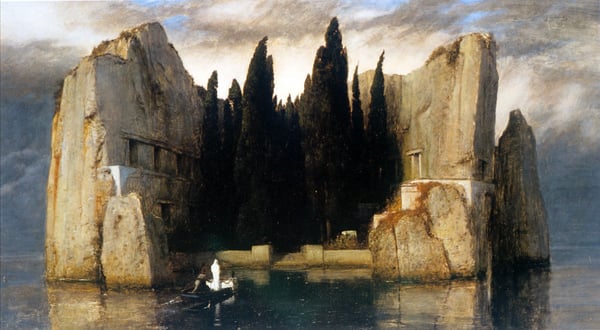
Arnold Böcklin’s The Isle of the Dead stands as a defining masterpiece of the Symbolist movement, exemplifying the style’s emphasis on introspective mood, mystery, and the evocative power of allegory. Created as an allegorical painting, the work transcends literal representation to dwell on themes of mortality, transition, and the unknown—central concerns of late-19th-century Symbolism.
Significance within Symbolism:
As a hallmark of Symbolism, the painting rejects direct narrative in favor of a dreamlike, almost silent atmospheric tension. The lone figure in a boat approaching a rocky, cypress-studded island becomes a potent emblem of the passage between life and death. Symbolist artists prioritized subjective emotion and suggestion over realistic detail, and Böcklin achieves this through a somber, twilight palette, stark vertical forms (cypresses, cliffs, oars), and a stillness that invites contemplation. The work’s open-ended symbolism—never explicitly identifying the figure or the destination—allows viewers to project their own fears, hopes, or meditations on the afterlife.
Significance as an Allegorical Painting:
As an allegory, The Isle of the Dead operates on multiple philosophical levels. The island, isolated and foreboding, can be read as the realm of the dead, the human soul’s final journey, or a psychological landscape of melancholy. The boat and its solitary passenger echo classical ferry motifs (like Charon crossing the Styx) while remaining deliberately ambiguous. This fusion of personal and universal symbolism gives the work its enduring power and made it an icon of its era, influencing later composers, writers, and filmmakers. Böcklin’s painting remains a quintessential example of how Symbolism used allegory to probe the ineffable.
Museum / Gallery
Visivamente simili
20 opere con composizione e palette affini
The Isle of the Dead
Arnold Böcklin
The Isle of the Dead
Arnold Böcklin

Il viaggio
Felice Pedretti
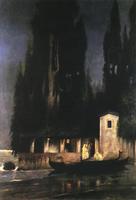
Departure from an Island at Night
Henryk Siemiradzki
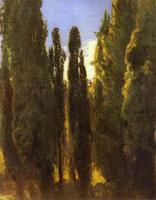
Cypresses in the Crimea
Fyodor Vasilyev
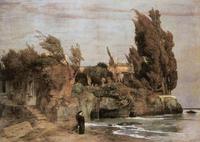
Villa by the Sea
Arnold Böcklin
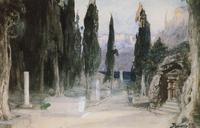
Cemetery among the cypress
Vasily Polenov
Cemetery
Vasily Polenov
Untitled
Zdzislaw Beksinski
Near Noroton, Connecticut
David Johnson
An Italianate Landscape
Vilhelms Purvitis
LATIUM LANDSCAPE WITH WAYFARERS NEAR A RIVER
Gaspar van Wittel
Untitled
Zdzislaw Beksinski
A rocky river landscape
Joachim Govertsz. Camphuysen
Untitled
Zdzislaw Beksinski
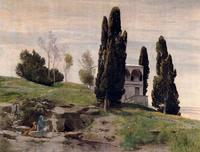
The Rest on the Flight into Egypt
Arnold Böcklin
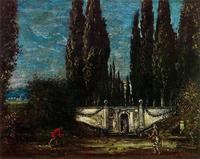
Villa Falconieri
Giorgio de Chirico

Circle
Albert Zimmermann
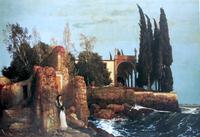
Villa by the Sea
Arnold Böcklin
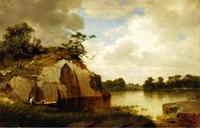
Catnip Island, Near Greenwich, Connecticut
David Johnson