Konstantin Bogaevsky sanatçısının Feodosia at winter eseri hakkında uzman analizi
Tarz: Symbolism · Tür: cityscape
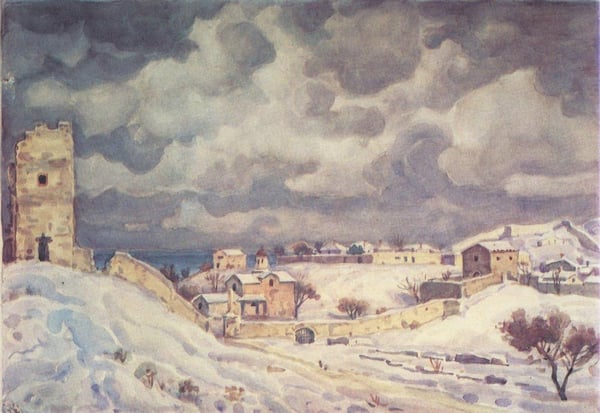
Expert Analysis: "Feodosia at winter" by Konstantin Bogaevsky
Konstantin Bogaevsky’s "Feodosia at winter" stands as a compelling example of Russian Symbolist cityscape painting, where the documentary precision of a real location is transformed into a vehicle for mood, memory, and metaphysical longing. Executed in the Symbolist tradition, the work transcends mere topographical record to evoke an atmosphere of quiet desolation and timeless stillness.
Significance within Symbolism and the Period
Bogaevsky was a key figure of the early 20th‑century Russian Symbolist movement, closely associated with the Blue Rose group. His art consistently sought to express inner spiritual states through landscape, often rendering the Crimean coast—his native region—as a mythic, dreamlike realm. "Feodosia at winter" exemplifies this approach: the cityscape is stripped of anecdotal detail, reduced to essential forms and subdued, monochromatic tonalities that suggest a world suspended between waking and dream, reality and allegory.
Composition and Symbolist Strategies
The painting likely employs a low horizon and broad expanses of snow-covered ground or frozen sea, with architectural silhouettes rendered in a deliberately simplified, almost archaic manner—reminiscent of early Renaissance or classical ruins. The winter palette of muted whites, grays, and icy blues creates a somber, elegiac mood, typical of Symbolism’s fascination with melancholy, transience, and the sublime. The absence of human figures (or their reduction to tiny, indistinct presences) reinforces the sense of a landscape imbued with solitude and eternal silence—a hallmark of Bogaevsky’s personal vision.
Contribution to the Symbolist Cityscape Genre
Unlike earlier city views that celebrated civic pride or naturalistic detail, Bogaevsky’s Feodosia becomes a symbolic archetype: a ghost‑city, a memory of past civilizations, or a threshold between the tangible and the otherworldly. The work thus occupies a significant place within Russian Symbolism by demonstrating how a specific, known locale can be elevated to a universal emblem of spiritual isolation and meditative calm. In doing so, Bogaevsky bridges the legacy of Romantic landscape painting and the emerging modernist concern with subjective, psychological space.
Tür
Stil
Görsel olarak benzer
İlişkili kompozisyon ve renk paletine sahip 20 eser
Winter Landscape with Church
Konstantin Gorbatov
Early Spring in Pskov
Konstantin Gorbatov
Pskov
Konstantin Gorbatov
Pskov. The fish market.
Mstislav Dobuzhinsky
Putivl
Nicholas Roerich
Pskov
Konstantin Gorbatov
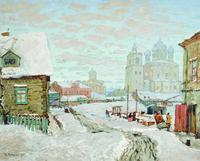
Old Pscov
Konstantin Gorbatov
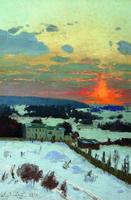
Sunset
Volodymyr Orlovsky
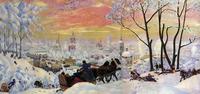
Shrovetide
Boris Kustodiev
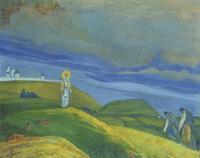
Saint Nicholas
Nicholas Roerich
To Troyitsa
Konstantin Yuon
Nizhny Novgorod
Volodymyr Orlovsky
Monastery in the snow
Konstantin Yuon
A Russian Town Under the Snow
Konstantin Gorbatov
Summer holiday
Boris Kustodiev
Pskov
Konstantin Gorbatov
To Troyitsa
Konstantin Yuon
Village with Two Figures
Konstantin Gorbatov
The View of Troitse-Sergiyev Monastery
Konstantin Yuon
Old Town. Winter
Konstantin Gorbatov