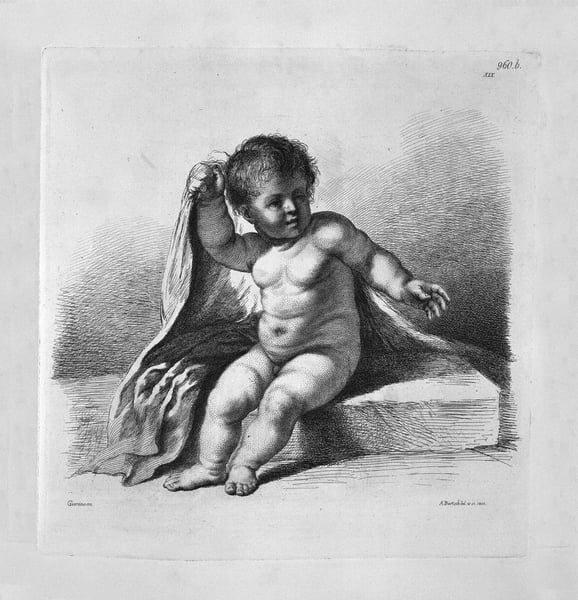
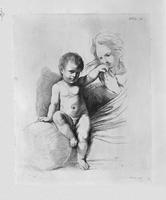
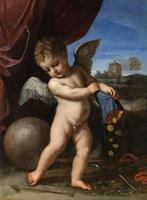
Cherub sitting in the act of covering, by Guercino
Dettagli
Analisi esperta di Cherub sitting in the act of covering, by Guercino di Giovanni Battista Piranesi
Stile: Neoclassicism · Genere: religious painting
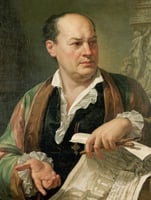
This artwork, Cherub sitting in the act of covering, by Guercino, is an etching by Giovanni Battista Piranesi—an artist renowned for his monumental architectural vedute and prison fantasies—here turning his hand to a religious subject derived from the Baroque master Giovanni Francesco Barbieri, called Guercino. Despite the original’s seventeenth-century dynamic energy, Piranesi reinterprets it through a Neoclassical lens, lending the cherub a sculptural clarity and balanced composure that elevate the piece beyond mere reproduction.
Stylistic and Technical Significance
Piranesi’s etching meticulously follows Guercino’s composition of a cherub seated in a covering gesture, yet the handling of line and shadow marks a shift from Baroque drama to Neoclassical restraint. The cherub’s rounded forms are defined with crisp, even hatchings that model the flesh like marble, while the drapery falls in ordered, almost architectural folds. This precision contrasts with Guercino’s more fluid, chiaroscuro-heavy approach, demonstrating how Piranesi translates a religious motif into a study of ideal form and classical proportion.
Context and Uniqueness
Piranesi is rarely associated with religious painting; his fame rests on his etched views of Rome and his fantastical Carceri series. This print, part of a set reproducing Guercino’s drawings, shows Piranesi’s versatility and his engagement with the foundational canon of Italian art. By rendering a cherub—a symbolic figure often used in Baroque altarpieces for emotional immediacy—with Neoclassical sobriety, Piranesi aligns the religious subject with the Enlightenment values of clarity, order, and archaeological fidelity. The “covering” gesture itself (the cherub’s action of drawing a cloth or veil) evokes both modesty and mystery, themes that Neoclassical artists often reframed as timeless, universal allegories rather than specific devotional triggers.
Significance within Neoclassicism
The piece exemplifies how Neoclassical artists revisited earlier masters not as simple copies but as revaluations. Here, Piranesi extracts the structural essence of Guercino’s cherub—its weight, its pose, its relationship to space—and presents it with the cool detachment of a classical bas-relief. This act of reinterpretation underscores Neoclassicism’s ambition to distill eternal beauty from historical sources, making the work significant as a bridge between the Baroque’s spiritual intensity and the Neoclassical pursuit of rational harmony.
Visivamente simili
20 opere con composizione e palette affini
Christ boy
Albrecht Durer
Seated Nude Child
Albrecht Durer
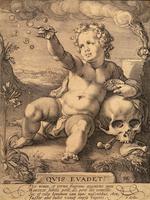
Who will be Spared?
Hendrick Goltzius
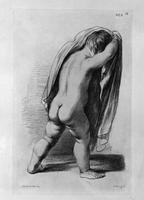
Putto standing in place to clothe itself, by Guercino
Giovanni Battista Piranesi
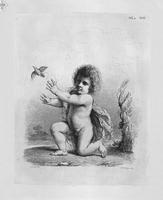
Cherub kneeling releasing a bird by Guercino
Giovanni Battista Piranesi
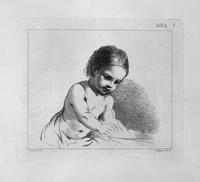
Cherub, half-length, by Guercino
Giovanni Battista Piranesi
Jesus To A Child to whom the Virgin kisses the hand, by Guercino
Giovanni Battista Piranesi
Study of the Christ Child
Albrecht Durer
Bacchus as a child
Jacob Jordaens
Sketch of Putto Holding a Sash in Both Hands, Seen from Below
Joshua Reynolds
Fortitude, from the Series the Seven Virtues
Lucas van Leyden
Infant St. John the Baptist
Jacques Stella
Joke of putti
Giovanni Battista Piranesi
Temperance (temperancia)
Lucas van Leyden
Kind Mit Wickenblüte
Philipp Otto Runge
Charity, from the Series the Virtues
Lucas van Leyden
Le Christ et saint Jean-Baptiste enfants dans un paysage
Jacopo Amigoni
Study of a Female Nude (Venus in a Drapery)
Bartholomeus Spranger
Cupid spurning riches
Guercino
Venus Punishing Profane Love
Agostino Carracci