Expert analysis of Richard Diebenkorn’s Woman in Profile
Style: Expressionism · Genre: portrait
Expert Analysis: "Woman in Profile" by Richard Diebenkorn
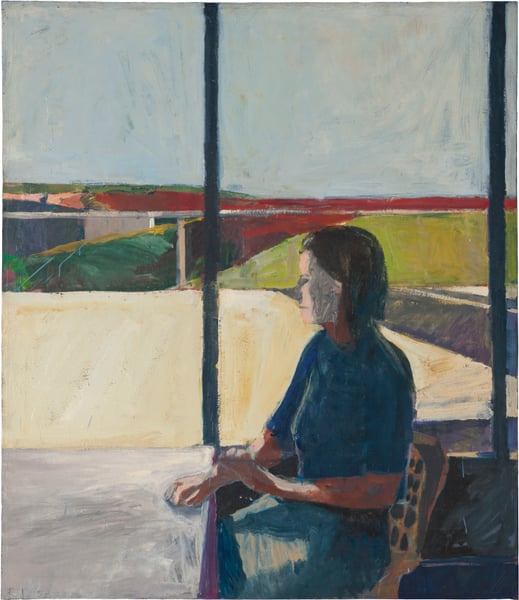
Richard Diebenkorn’s Woman in Profile stands as a pivotal work within the trajectory of American Expressionism, specifically marking his engagement with figuration during the late 1950s and early 1960s. While the artist first gained renown for his Abstract Expressionist canvases, this portrait exemplifies his transition into the Bay Area Figurative movement—a critical moment when he reintroduced recognizable form without abandoning the emotional intensity and gestural energy of his earlier abstraction.
Stylistic Significance
As an Expressionist portrait, the work does not prioritize photographic likeness. Instead, Diebenkorn uses vigorous, layered brushwork and a muted yet resonant palette to convey psychological presence. The profile view is deliberately flattened and simplified, echoing the planar compositions of his abstract period (e.g., the Berkeley series). The figure is both anchored in space and dissolved into the surrounding environment—her form constructed from broad, painterly strokes that suggest mass and movement simultaneously. This technique underscores the tension between representation and abstraction, a hallmark of Diebenkorn’s mature style.
Genre Innovation
Within the portrait genre, Woman in Profile is significant for treating the human subject not as a static icon but as a vessel for light, atmosphere, and emotional resonance. The sitter’s anonymity (no identifying features) allows the viewer to focus on the act of perception itself: how paint, color, and composition create a ‘presence.’ This aligns with Expressionism’s core goal—to externalize inner feeling—yet Diebenkorn tempers raw emotion with a refined sense of structure, borrowing the confident drawing of Matisse and the spatial adjustments of Cézanne.
Historical Context
The work is also important for challenging the mid-century orthodoxies that demanded absolute non-objectivity. At a time when Abstract Expressionism dominated American art, Diebenkorn’s return to the figure was viewed as a bold reclamation of human experience—a move that influenced subsequent generations of figurative painters in California and beyond. The painting’s balance between gestural freedom and controlled composition makes it a key example of how Expressionism could remain vital even when tethered to the visible world.
Visually similar
20 works with related composition and palette
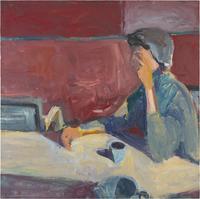
Woman at Table in Strong Light
Richard Diebenkorn
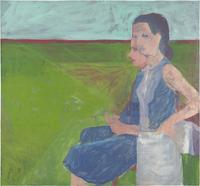
Women Outside
Richard Diebenkorn
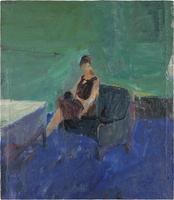
Seated Woman, Green Interior
Richard Diebenkorn
Girl with Flowers
Roland Petersen
Model Drinking Coffee
Paul Wonner
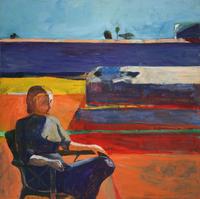
Woman on Porch
Richard Diebenkorn
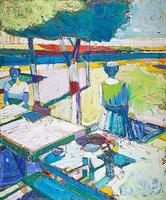
Two Figures in a Golden Land
Roland Petersen
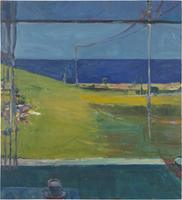
Ocean from a Window
Richard Diebenkorn
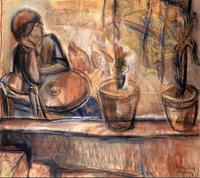
Egry József, Annuska
Egry József
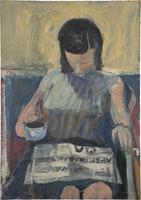
Woman with a Newspaper
Richard Diebenkorn
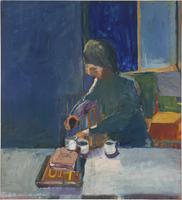
Girl and Three Coffee Cups
Richard Diebenkorn
Czóbel Béla Fiatal Lány a Műteremben, Olaj, Vászon, 73.5x54cm
Bela Czobel
Béla Czóbel, Lajos, 1975
Bela Czobel
Czóbel Béla , Fiatal Nő Műteremben
Bela Czobel
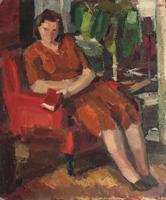
Young Woman in Interior
Francisc Sirato
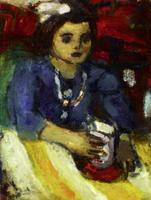
Piac Sarka
Bela Czobel
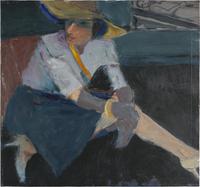
Woman in Hat and Gloves
Richard Diebenkorn
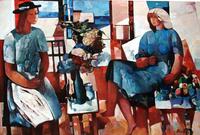
Girls
Rudolf Bér
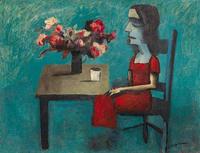
Barbara at the Table
Charles Blackman
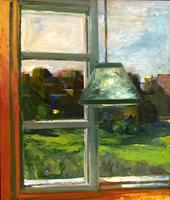
Green Lampshade
Elmer Bischoff