
Analisi esperta di At the Sink di Fyodor Vasilyev
Stile: Realism · Genere: cityscape
Artwork Analysis: "At the Sink" by Fyodor Vasilyev
Fyodor Vasilyev, a key figure in Russian Realism, is celebrated for his profound sensitivity to nature and the ordinary rhythms of life. While best known for his evocative landscapes, "At the Sink" demonstrates his versatility within the cityscape genre—a field often reserved for documenting urban existence. This work’s significance lies in its ability to elevate a mundane, domestic corner of the city into a moment of quiet, universal truth, exemplifying the core tenets of Realism.
Composition and Subject Matter
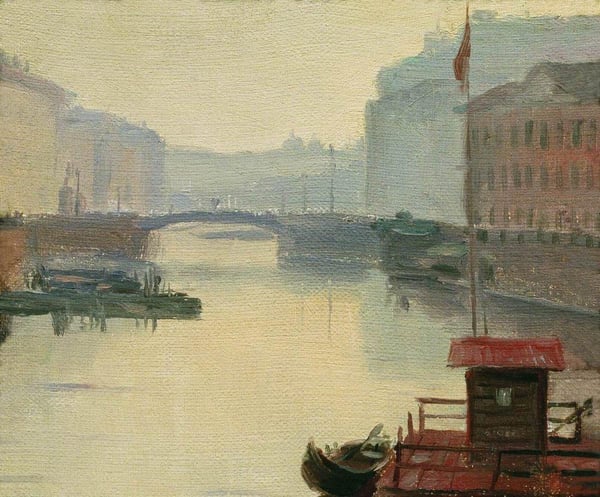
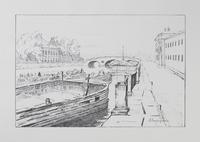
The painting focuses on a simple, everyday scene: a sink, likely in a courtyard or a public washhouse, within an urban setting. Vasilyev avoids grand monuments or bustling thoroughfares; instead, he zeros in on a humble, functional fixture. The sink serves as a stage for human presence, perhaps implied through wet footprints, a forgotten cloth, or the trickle of water. By choosing this unglamorous subject, Vasilyev aligns with Realism’s commitment to depicting the lives of ordinary people and the spaces they inhabit—a direct challenge to the idealized or exoticized themes favored by academic art.
Light and Atmosphere
Realist cityscapes often rely on atmospheric truth, and Vasilyev masters this. The play of natural light—possibly soft morning or evening light filtering through a narrow alley—transforms the sink into a study of texture and reflection. The wet stone, the sheen on metal, and the shadows cast by unseen walls create a palpable sense of place. This attention to ambient light not only grounds the scene in a specific time of day but also infuses it with a melancholic, contemplative mood, a hallmark of Vasilyev’s style that distinguishes his work from more reportorial city views.
Social and Artistic Significance
Within the context of 19th-century Russian Realism, "At the Sink" is significant for its refusal to romanticize urban life. While contemporary painters often depicted city poverty as either picturesque or sentimental, Vasilyev presents the scene with neutral dignity. The sink is not a symbol of hardship but simply a fact—a quiet testament to the daily labor and routine that underpin city existence. This matter-of-fact treatment underscores Realism’s revolutionary aim: to make art from the unremarkable, to find poetry in the prosaic.
Furthermore, Vasilyev’s early death (he passed away at 23) lends added poignancy to works like this one. They represent a brief but intense career where he consistently pushed landscape and cityscape beyond mere documentation, imbuing them with emotional resonance. "At the Sink" is thus a prime example of how Realism could transform the cityscape from a record of urban geography into a mirror of lived experience—fragile, intimate, and deeply human.
Visivamente simili
20 opere con composizione e palette affini
A View of St.petersburg
Konstantin Gorbatov
Leningrad. Fontanka and the Summer Garden in frost.
Anna Ostroumova-Lebedeva
Fontanka
Boris Kustodiev
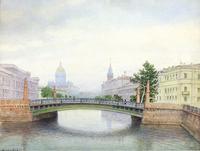
Potseluyev bridge
Albert Benois
Illumination on the Moika Embankment in St. Petersburg
Vasily Sadovnikov
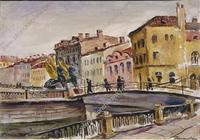
Leningrad. Lions Bridge.
Pyotr Konchalovsky
Fontanka
Anna Ostroumova-Lebedeva
Bolshaya Neva
Alexey Bogolyubov
Leningrad. Summer garden in winter.
Anna Ostroumova-Lebedeva
The Griboedov Canal in St.Petersburg
Konstantin Gorbatov
Leningrad. The bridge on the canal.
Pyotr Konchalovsky
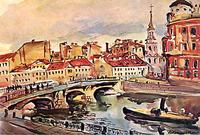
Leningrad. Bridge of Belinsky. Church of St. Simeon and Anna.
Pyotr Konchalovsky
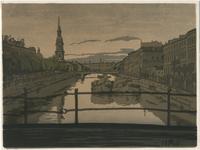
Petersburg. Kryukov Canal.
Anna Ostroumova-Lebedeva
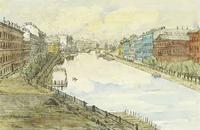
Petersburg. Fontanka.
Anna Ostroumova-Lebedeva
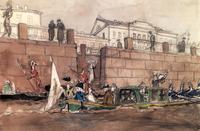
Carnival on the Fontanka River
Alexandre Benois
Leningrad. Bank Bridge.
Pyotr Konchalovsky
Kalinkin Bridge
Eugene Lanceray
Friedrichsgracht bei Mondschein
Adolph Menzel
Leningrad. Neva.
Pyotr Konchalovsky
Fontanka near the Summer Garden
Anna Ostroumova-Lebedeva