Expertenanalyse zu Fyodor Vasilyevs Barges on Volga
Stil: Realism · Genre: landscape
Expert Analysis: "Barges on Volga" by Fyodor Vasilyev
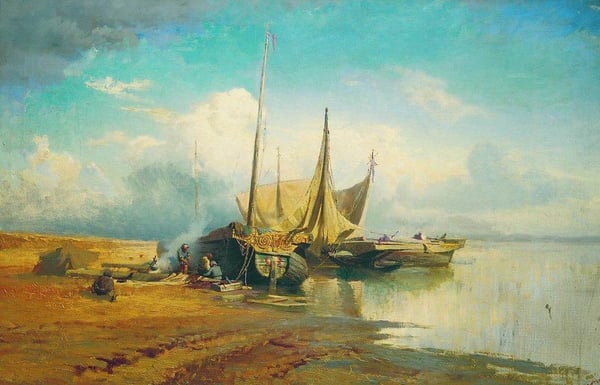
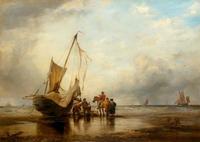
Fyodor Vasilyev’s Barges on Volga stands as a masterwork of Russian Realist landscape painting, distinguished by its lyrical yet unflinching portrayal of the river as both a majestic natural force and a stage for human toil. Though the artist died at only 23, this painting encapsulates his remarkable ability to infuse a seemingly straightforward landscape with profound emotional and social resonance.
Composition and Technique Vasilyev organizes the canvas around the sweeping curve of the Volga, leading the eye from the foreground barges—dark, heavy forms laden with goods—toward a luminous, expansive sky. The crisp realism of the barges’ hulls and the figures aboard anchors the scene in tangible labor, while the soft gradations of cloud and water reflect his keen observation of atmospheric effects. His brushwork is both precise (in the rigging and wood grain of the boats) and fluid (in the rippling water and distant haze), balancing documentary detail with painterly freedom.
Significance within Realism
- Human Presence as a Scale of Nature: Unlike many Western Realists who isolated landscape from human activity, Vasilyev integrates the barges and their unseen laborers as a quiet, unheroic counterpoint to the vastness of the Volga. This echoes the social concerns of contemporary Russian artists (e.g., Ilya Repin’s Barge Haulers on the Volga), yet Vasilyev avoids overt political commentary. Instead, the struggle is implied through the weight of the vessels and the muted, exhausted tones of the riverbank.
- Mood and Light: Vasilyev’s treatment of light is distinctly Russian—soft, diffused, and melancholy. The silvery-grey sky and the cool blues of the water create an atmosphere of transience and quiet endurance. This tonal subtlety, rooted in plein-air observation, marks a departure from the dramatic chiaroscuro of earlier Romantic landscapes and aligns Vasilyev with the emerging Russian tradition of mood painting (later perfected by Levitan).
- Technical Mastery at a Young Age: Completed late in Vasilyev’s tragically short career, Barges on Volga demonstrates his rapid maturation. The confident handling of perspective—the river narrowing into the distance; the overlapping planes of boat, bank, and sky—shows a painter fully in control of spatial depth, often a challenge in river landscapes.
Legacy This painting is significant because it embodies the intersection of two vital currents in 19th-century Russian art: the demand for honest, unidealized representation of national life (the Realist imperative) and the emerging search for a distinctively Russian poetic landscape. Vasilyev’s work would directly influence later masters like Isaac Levitan, who cited him as a crucial predecessor. Barges on Volga remains a testament to how Realism, in Vasilyev’s hands, could transcend mere documentation to achieve a resonant, almost allegorical power—where the river becomes both a literal venue for labor and a metaphor for the slow, inexorable flow of Russian life.
Visuell ähnlich
20 Werke mit ähnlicher Komposition und Farbpalette
At the River. Windy Day
Fyodor Vasilyev
Reflections of a becalmed fishing fleet
Joseph Stannard
Evening. Seashore.
Volodymyr Orlovsky
Sailboats. Study
Fyodor Vasilyev
Fishing Boats in Bruges, Belgium
James Webb
Pêcheurs à marée basse
Eugene Isabey
Beached Vessels and a Wagon near Trouville France
Richard Parkes Bonington
Scheveningen, Holland
James Webb
Fishing boats
Konstantinos Volanakis
At Dordrecht, Holland
James Webb
Sunset over the bay
Konstantinos Volanakis
?
Eugene Isabey
Moored sailing ships on a calm afternoon
Abraham Hulk Sr.
Dutch river landscape with boats
Frans Arnold Breuhaus de Groot
Evening Scene
James Webb
Evening Elbe landscape with moored fishing barges
Carl Julius von Leypold
Fischerboote Im Sturm Vor Der Holländischen Küste Bei Den Helder
Abraham Storck
Landing the Catch
Samuel Owen

The Return of the Fishing Boats
William Collins
Brighton Sands
Edward William Cooke