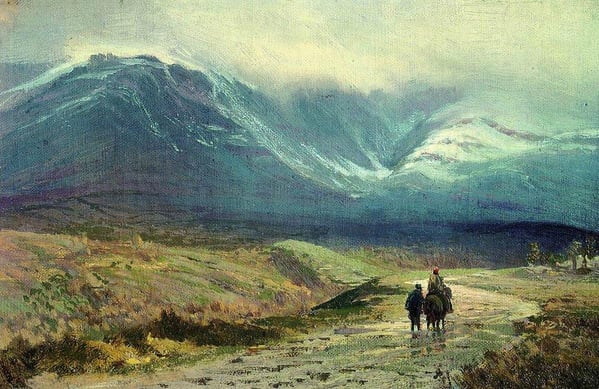
Expert analysis of Fyodor Vasilyev’s In the Crimea. After a Rain
Style: Realism · Genre: landscape
Expert Analysis: "In the Crimea. After a Rain" by Fyodor Vasilyev
Fyodor Vasilyev’s "In the Crimea. After a Rain" is a masterful example of Realist landscape painting from the late 19th century, a period when Russian artists sought to depict nature with unembellished truth and emotional resonance. Executed in the Realist style, the work belongs to the landscape genre, yet it transcends mere topographical record through its atmospheric sensitivity and poignant mood.
Significance within Realism and the Landscape Genre:
What makes this painting significant is Vasilyev’s ability to capture a transient meteorological moment—the aftermath of rain—with a fidelity that elevates the everyday scene into a lyrical meditation on nature’s renewal. The artist eschews dramatic, idealized vistas in favor of a quiet, intimate view of the Crimean landscape after a downpour. The damp earth, the reflective pools of water, the shifting clouds breaking to reveal light—these are rendered not as static elements but as living, breathing phenomena.
In the context of 19th-century Russian Realism, Vasilyev belonged to the generation of painters who rejected academic conventions and followed the principle of pravda (truth). His landscapes, including this one, are celebrated for their emotional depth and atmospheric precision. Here, the rain has just ceased; the air is heavy with moisture, and the colors are subdued yet luminous—muted greens, soft grays, and the silver-gray of a clearing sky. Vasilyev’s brushwork is both delicate and assured, suggesting the wetness of the ground and the gentle diffusion of light without overworking the surface.
Contribution to the Evolution of Landscape Painting:
Though Vasilyev died tragically young (at age 23) in 1873, his work—especially such scenes as "In the Crimea. After a Rain"—bridged the early Realist tradition of plein-air observation and the more poetic, evocative landscapes that would follow in the hands of artists like Ivan Shishkin and Isaac Levitan. This painting is significant because it demonstrates how Realism could transcend mere documentation: it becomes a vehicle for expressing the quiet grandeur of nature’s cycles and the fleeting beauty of a moment caught between storm and sunshine. The work stands as a testament to Vasilyev’s conviction that even the most ordinary aftermath of rain can be a subject of profound artistic reflection.
Museum / Gallery
Visually similar
20 works with related composition and palette
Near Festiniog
David Bates
Mountains in the Crimea in Winter
Fyodor Vasilyev
The Drove Road
George Harvey
Peat Moss, Poolewe
Joseph Farquharson
Near Loch Loi, Argyllshire
Joseph Adam
Landscape
Benjamin Champney
Rob Roy's Castle, Scotland
George Harvey
Hackery
Volodymyr Orlovsky
Herding Sheep
Tom Scott
The Fading Many Coloured Woods
Joseph Farquharson
HERDSMAN AND COWS ON A COUNTRY ROAD, GLENMALURE, COUNTY WICKLOW
Nathaniel Hone the Younger
Great Orme Head from the Mouth of the Conwy, North Wales
David Cox
Landscape Study from Vågå
Hans Gude
Mount Washington
Albert Bierstadt
The Howard Townsed Family Taking a Break from a Highland Shoot
Francis Davis Millet
Clouds over Hills. Study
Fyodor Vasilyev
HIGHLAND LANDSCAPE
Alfred Augustus Glendening, Sr.
Mountain of Memory
Adam Abram
River in the foothills
Lev Lagorio
Hay Time on the High Moors
David Bates