Fyodor Vasilyev sanatçısının Wet Meadow 1. Study eseri hakkında uzman analizi
Tarz: Realism · Tür: landscape
As an expert art historian, I offer the following analysis of "Wet Meadow 1. Study" by Fyodor Vasilyev.
Artwork Analysis: "Wet Meadow 1. Study" (1871)
Artist: Fyodor Vasilyev (Russian, 1850–1873)
Style: Realism (specifically, the lyrical landscape tradition within Russian Realism)
Genre: Landscape
Significance Within the Realist Movement
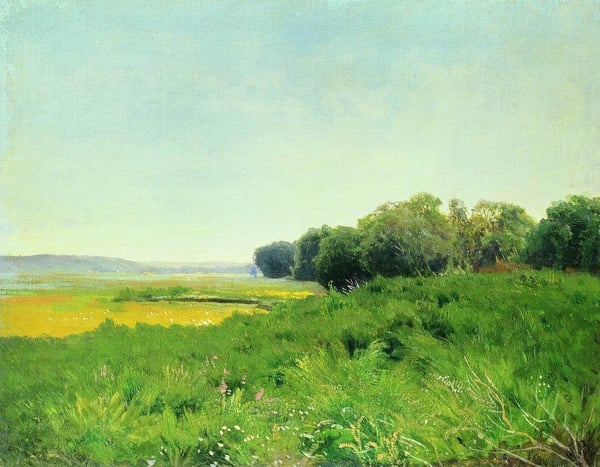
Fyodor Vasilyev's "Wet Meadow 1. Study" is a landmark work that exemplifies the shift from the idealized, heroic landscapes of academic Romanticism toward a more intimate, truthful, and emotionally resonant observation of nature. Executed as a study, it captures a fleeting, atmospheric moment with extraordinary sensitivity, revealing the core of Vasilyev's genius: his ability to infuse a specific place with a universal, almost melancholic, lyricism.
What makes this artwork extraordinary:
-
Mastery of Transient Atmosphere: Like many Russian Realists, Vasilyev was obsessed with the "truth" of nature—not a static, composed truth, but the truth of changing weather and light. In Wet Meadow, he focuses on the moment just after a storm has passed. The sky is a complex theater of heavy, departing rain clouds and breaking patches of pale sunlight. The wet ground, which gives the work its title, reflects the unstable sky, creating a unified, moody tonal harmony. This is not a picturesque view; it is a study of a specific meteorological event, a hallmark of the Realist commitment to empirical observation.
-
Emotional Resonance Through Restraint: Vasilyev was only 21 when he painted this, yet he was already dying of tuberculosis. The work carries a palpable sense of poignant solitude. The broad, waterlogged meadow stretches to a distant, dark forest, and a lone path meanders toward a solitary figure. The palette is subdued—muted greens, ochres, and leaden grays—punctuated only by the silvery light breaking through. This restraint avoids sentimentality, instead creating a deep, quiet sadness that is both personal and universal. The "study" format—direct from nature, unfinished in a polished sense—enhances its authenticity and emotional immediacy.
-
Technical Innovation in Realism: Vasilyev breaks from the detailed, tight brushwork of earlier landscape painting. He uses broad, fluid strokes for the sky and grass, and the wet ground appears almost blurred, as if the water is still settling. This technique, while rooted in direct observation, prefigures the looser, more expressive handling of later Russian landscape painters like Isaac Levitan. The study's unfinished quality is not a flaw but a deliberate choice to capture the fleeting impression—a key tenet of pre-Impressionist Realism.
Ultimately, "Wet Meadow 1. Study" is significant because it demonstrates how Russian Realism used the most humble landscape subjects to explore profound themes of time, change, the human spirit's relationship with nature, and the artist's own mortality. It is a quiet masterpiece that elevates the "study" from a mere preparatory sketch to a complete, deeply moving work of art.
Museum / Gallery
Görsel olarak benzer
İlişkili kompozisyon ve renk paletine sahip 20 eser
Vyatka River
Viktor Vasnetsov
A day in June
Isaac Levitan
Landscape
Isaac Levitan
Late Afternoon
Robert Julian Onderdonk
Afternoon Shadows
William Merritt Chase
Autumn morning
Isaac Levitan
Last Rays
Victor Puzyrkov
Pine Grove in the Swamp
Fyodor Vasilyev
A Silent Pool - Autumn
Edward Wilkins Waite
River Scene
Frank W. Benson
Windy day
Isaac Levitan
The road to the violet
Sattar Bahlulzade
Edge of the deciduous forest
Ivan Shishkin
At the field
Volodymyr Orlovsky
Evening shadows
Isaac Levitan
Landscape
Isaac Levitan
Glimpse of the Sea, Long Island
Robert Julian Onderdonk
Gray day.
Isaac Levitan
Landscape with lake
Ivan Shishkin
Distance
Ivan Shishkin