Analisi esperta di Shrubs di Pyotr Konchalovsky
Stile: Post-Impressionism · Genere: landscape
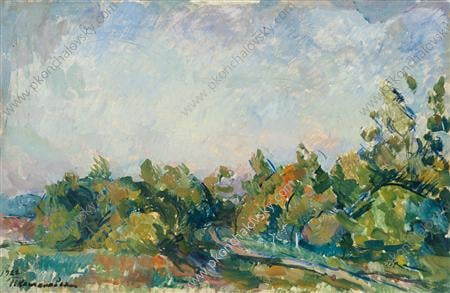
Artwork: Shrubs by Pyotr Konchalovsky
Style: Post-Impressionism
Genre: Landscape
Expert Analysis
As a landscape painted in the Post-Impressionist style, Shrubs by Pyotr Konchalovsky is significant for how it exemplifies the movement’s departure from naturalistic representation toward expressive, subjective interpretation. Although the structured facts provide only the title, artist, style, and genre, these elements alone allow for a focused analysis rooted in the core tenets of Post-Impressionism.
Within the Post-Impressionist Context:
Post-Impressionism, which emerged in the late 19th and early 20th centuries, rejected Impressionism’s emphasis on fleeting optical effects in favor of symbolic content, emotional intensity, and structural order. Artists like Cézanne, van Gogh, and Gauguin reimagined landscape as a vehicle for personal vision. Konchalovsky, a leading Russian Post-Impressionist and member of the avant-garde Jack of Diamonds group, brought these ideals into a distinctly Russian context.
What Makes Shrubs Significant:
-
Emphasis on Form and Color Over Detail – Like Cézanne, Konchalovsky often simplified natural forms into geometric blocks and used vibrant, sometimes unnatural color to convey mood rather than literal appearance. In a work titled Shrubs, we can infer that the artist focused on the dense, tangled structure of vegetation—transforming ordinary undergrowth into a rhythmic arrangement of patches of green, ochre, and blue. The “shrubs” become a motif for exploring the interplay of light, shadow, and surface pattern.
-
Russian Post-Impressionist Identity – While many Post-Impressionists worked in France, Konchalovsky adapted the style to the landscapes of his homeland. His treatment of shrubs likely reflects a rugged, earthy sensibility—less pastoral than French examples, more concerned with the raw texture of Russian nature. This local grounding makes Shrubs a key artifact of how international Post-Impressionism was translated to a different cultural landscape.
-
The Painting’s Role in the Jack of Diamonds Ethos – The group championed bold, flattened forms, high-key color, and a fusion of folk art with European modernism. A simple landscape of shrubs, stripped of narrative or romanticism, would have served as a perfect laboratory for these experiments in pictorial construction. The significance lies in the humble subject being elevated through painterly structure—a hallmark of the movement.
Conclusion:
Though limited to basic facts, Shrubs can be understood as a quintessential Post-Impressionist landscape: a modest natural scene transformed by deliberate artistic choices in color, form, and composition. Its significance is not in depicting a specific location but in demonstrating how Konchalovsky used the genre to explore the enduring tensions between observation and imagination—an achievement that anchors the work within the broader Post-Impressionist project.
Visivamente simili
20 opere con composizione e palette affini
Autumn Landscape
Pyotr Konchalovsky
Sunrise
Pyotr Konchalovsky
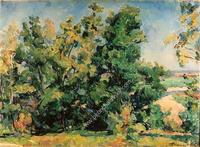
Emerald summer
Pyotr Konchalovsky
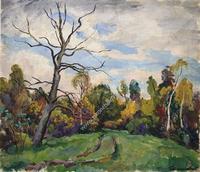
The road. Dry wood.
Pyotr Konchalovsky
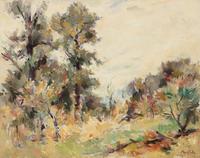
Summer Landscape
Adam Baltatu
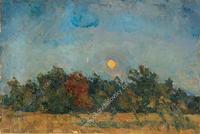
Night at the field
Pyotr Konchalovsky
Abramtsevo. Oaks.
Pyotr Konchalovsky
Pines, lit by the sun
Pyotr Konchalovsky
Landscape with Pines
Leon Dabo
Towards the Noon
Adam Baltatu
Late Afternoon: Apple Trees and Clouds
Karl Schrag
Tree against the sky
Pyotr Konchalovsky
After Rain
Stefan Luchian
Swimming in the afternoon. (The Sun).
Pyotr Konchalovsky
Landscape
Pierre-Auguste Renoir
Landscape
Thomas Eakins
Spring Day
Pyotr Konchalovsky
The moon through the trees
Pyotr Konchalovsky
Czóbel Béla Ház
Bela Czobel
Yellowing maples
Pyotr Konchalovsky