Analisi esperta di Silver poplar trees di Pyotr Konchalovsky
Stile: Post-Impressionism · Genere: landscape
Expert Analysis of "Silver Poplar Trees" by Pyotr Konchalovsky
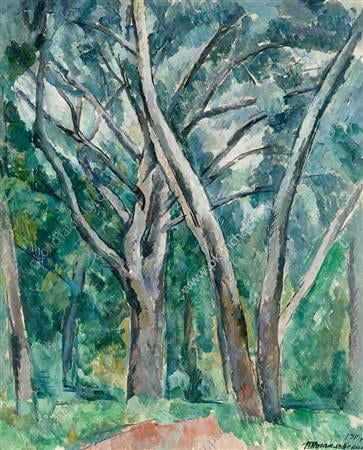
Pyotr Konchalovsky’s Silver Poplar Trees is a landscape executed in the Post-Impressionist style, a movement that sought to extend Impressionism’s concern with light and color into more structured, expressive, and often symbolic territory. As a leading member of the Russian avant-garde group Jack of Diamonds, Konchalovsky was deeply influenced by Paul Cézanne and the French Post-Impressionists, and this painting exemplifies his effort to synthesize French pictorial innovation with a distinctly Russian sensibility.
Significance within Post-Impressionism and Konchalovsky’s Oeuvre:
-
Structural Composition and Cézannesque Influence: Konchalovsky’s treatment of the poplars is not merely naturalistic but architectural. The trees are arranged in a rhythmic, almost geometric pattern—their vertical trunks and silver foliage creating a lattice-like screen that divides the picture plane. This reflects Cézanne’s dictum of “treating nature by the cylinder, the sphere, the cone,” and marks a departure from the fleeting atmospheric effects of Impressionism toward a more permanent, constructed vision of landscape. The “silver” of the title is key: the artist uses muted, silvery-grey greens and pale blues to evoke the shimmering light on the leaves, but this luminosity is anchored by strong, dark outlines and a firm sense of volume.
-
Color as Emotional and Formal Tool: Post-Impressionism often prioritized expressive color over optical accuracy. Here, Konchalovsky’s palette—ranging from cool silver and sage to earthy ochres and deep umbers—creates a contemplative, almost melancholic mood. The silvery tones are not literal but symbolic, imparting a hushed, metallic quality that distinguishes the work from the brighter, more saturated palettes of his French contemporaries. This color choice also reveals Konchalovsky’s attraction to the raw, textured landscapes of central Russia, where poplars are common, and his ability to render them with both vigor and restraint.
-
Bridging Russian and European Modernism: Konchalovsky played a crucial role in importing Post-Impressionist principles into Russian art. Silver Poplar Trees demonstrates how he adapted the spatial compression and faceted brushwork of Cézanne to a native subject, achieving a synthesis that felt both modern and rooted. The painting stands as a document of the Jack of Diamonds group’s mission: to combine the structural rigor of the French avant-garde with the earthy, folk-inflected vitality of Russian landscape painting.
-
Textural Richness and Painterly Gesture: The facture is deliberately visible—thick, varied brushstrokes that build up the surface of the foliage and bark. This tactile quality aligns with Post-Impressionism’s emphasis on the materiality of paint as an expressive medium in its own right. The silver poplars are rendered not as transparent atmospheres but as dense, palpable forms, inviting the viewer to experience the landscape as a constructed object rather than a mere window onto nature.
Conclusion: Silver Poplar Trees is significant because it crystallizes Konchalovsky’s mature Post-Impressionist idiom—a language of structural form, restrained yet emotive color, and robust texture—while also serving as a key example of how Russian artists of the early 20th century reimagined Western European modernist ideas within their own cultural landscape. It is a work that both honors the legacy of Cézanne and asserts a uniquely Russian lyrical strength.
Visivamente simili
20 opere con composizione e palette affini
Le Carrefour De Malabry
Henri Matisse
Douglas Hall
Samuel Peploe
Forest near the rocky caves above the Chateau Noir
Paul Cezanne
Oak tree
Pyotr Konchalovsky
Oaks in the park
Pyotr Konchalovsky
Landscape
Samuel Peploe
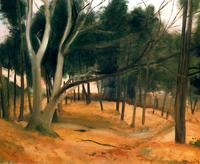
The Path of forest
Andre Derain
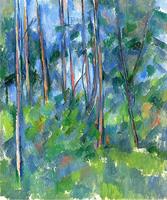
In the Woods
Paul Cezanne
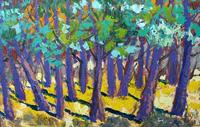
Thick forest
Endre Bartos
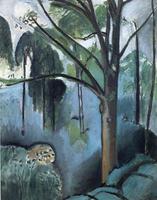
Trivaux Pond
Henri Matisse
Forest
Paul Cezanne
Trees at Mimizan
Winston Churchill
Waldlandschaft
Otto Mueller
Landscape of Cascine
Giorgio de Chirico
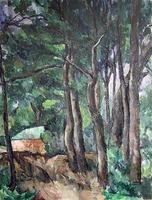
Trees
Pyotr Konchalovsky
Landscape (mountains)
Umberto Boccioni
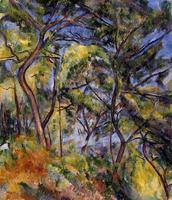
Forest
Paul Cezanne
Paysage À Collioure
Henri Matisse
Abramtsevo. Mall.
Pyotr Konchalovsky
Trees
Ivan Shishkin