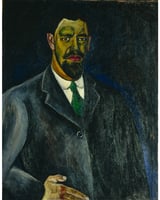
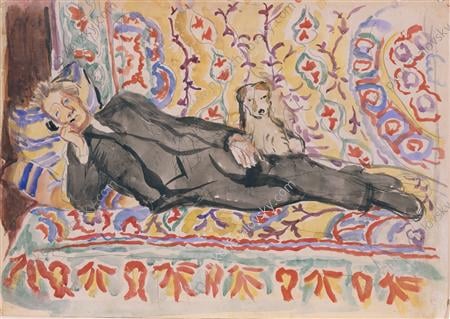
Sketch of portrait of Vsevolod Meyerhold
Dettagli
Analisi esperta di Sketch of portrait of Vsevolod Meyerhold di Pyotr Konchalovsky
Stile: Expressionism, Fauvism · Genere: sketch and study
This artwork, a sketch for a portrait of the legendary theater director Vsevolod Meyerhold by Pyotr Konchalovsky, is significant as a vivid intersection of Fauvist color and Expressionist energy, distilled into the raw, immediate language of a study.
Within the context of Konchalovsky’s career and Russian avant-garde art, the work stands out for its radical simplification and emotional intensity. The sketch format—typically a preparatory tool—is here elevated to a finished statement, its apparent spontaneity capturing both the restless dynamism of Meyerhold’s personality and the modernist ethos that championed process over polished finish.
The Fauvist influence is evident in the bold, arbitrary colors and the aggressive, non-naturalistic palette. Rather than modeling form through subtle gradations, Konchalovsky uses thick, slashing strokes of pure pigment—often applied straight from the tube or palette knife—to construct Meyerhold’s features. These strokes do not merely describe; they perform the energy of the sitter, a pioneer of biomechanics and avant-garde theater. The face becomes a mask of vibrating hues—blues, greens, oranges—that push beyond mere likeness into psychological projection.
Simultaneously, the Expressionist impact is felt in the distortion of anatomy and the palpable sense of urgency. The brushwork is loose, almost violent in places, with the paper’s texture left exposed to heighten the tactile immediacy. This is not a patient academic study but a direct transcription of a kinetic, even feverish encounter between artist and subject. The unfinished areas and visible pentimenti (changes of mind) are not flaws but deliberate markers of spontaneity, emphasizing the sketch as a record of creative decision-making.
Historically, this work bridges Konchalovsky’s early Fauvist phase (learned during his time in Paris under Matisse’s sphere) and his later engagement with Russian Constructivist and theatrical circles. Meyerhold, a figurehead of theatrical rebellion, is an apt subject: the portrait’s fractured, electrified surface mirrors his own revolutionary approach to staging, where light, movement, and gesture were fragmented and reassembled. As a sketch, it also embodies the Jack of Diamonds group’s valorization of the esquisse (sketch) as a legitimate, autonomous artwork—a break from academic hierarchy.
In sum, this work’s significance lies in how it condenses the key traits of Fauvism (unleashed color) and Expressionism (emotive distortion) into a lean, explosive format. It is a portrait not merely of a man, but of an era’s artistic and theatrical avant-garde, captured in the act of becoming—unfixed, incomplete, and alive.
Visivamente simili
20 opere con composizione e palette affini
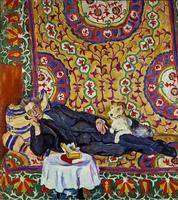
Portrait of director Vsevolod Emilievich Meyerhold
Pyotr Konchalovsky
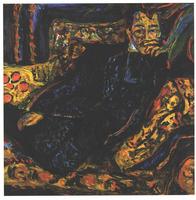
Portrait of Hans Frisch
Ernst Ludwig Kirchner
Portrait of Andreas Vurlumis
George Mavroides
Portrait of Edmond Maitre (The Reader)
Pierre-Auguste Renoir
Seated Figure
Francis Bacon
Professor Corbetta
Varlin
Study for `The Little Tea Party'
Walter Sickert
Woman in Black
Theodor Pallady
Pihenő
Bela Czobel
Zongoránál
Bela Czobel
Portrait of composer Aram Khachaturian
Martiros Sarian
Portrait of Francis Edward James
Philip Wilson Steer
Edouard Manet Standing
Edgar Degas
Self Portrait
George Bouzianis
Portrait of the artist Adolf Pichler
Isidoro Grünhut
Czóbel Béla. .
Bela Czobel
Berény Róbert, Ülő Nő Enteriör
Berény Róbert
Portrait of D.F. Bogoslovsky
Boris Kustodiev
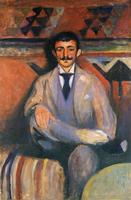
The Painter Jacob Bratland
Edvard Munch
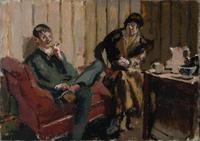
The Little Tea Party Nina Hamnett and Roald Kristian
Walter Sickert