Pyotr Konchalovsky sanatçısının Sketch of still life with bread eseri hakkında uzman analizi
Tarz: Fauvism · Tür: sketch and study
Expert Analysis: Sketch of Still Life with Bread by Pyotr Konchalovsky
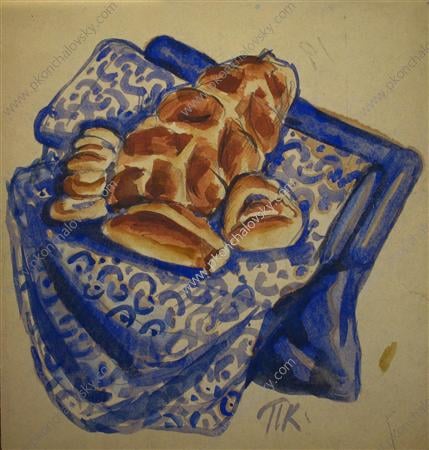
This work is a compelling example of Fauvism applied to a humble domestic subject—a still life centered on bread. As a sketch and study, it strips away finish to reveal the artist’s raw, immediate response to form and color, making it significant for understanding both Konchalovsky’s practice and the broader Fauvist movement.
Significance within Fauvism
Fauvism celebrated the liberation of color from naturalistic description, and Konchalovsky’s sketch embodies this principle. The bread, typically a warm, earthy loaf, is likely rendered in bold, non‑naturalistic hues—perhaps oranges, yellows, or even touches of violet—applied with energetic, visible brushstrokes. The “sketch” format heightens the spontaneity: there is little concern for precise modeling or perspective; instead, the artist captures the essence of the object through vibrant, unblended patches of pigment. This aligns with the Fauvist goal of expressing emotion and sensation through color, rather than replicating reality.
Genre as a Study
The designation “sketch and study” is crucial. It suggests Konchalovsky used this piece as a laboratory for exploring compositional balance, color relationships, and the expressive potential of a simple form. In Fauvism, even a preparatory work can be a finished aesthetic statement. Here, the bread’s crust and crumb become a vehicle for painterly experimentation—how a few strokes can suggest volume, texture, and weight. The sketch’s unfinished quality invites the viewer to participate in the artist’s thought process, emphasizing the process over the product.
Cultural and Artistic Context
Konchalovsky was a leading Russian Fauvist and a member of the avant‑group “Jack of Diamonds,” which admired French Fauvists (Matisse, Derain) and Paul Cézanne. This sketch likely echoes Cézanne’s still lifes in its geometric simplification of form, but the Fauvist palette pushes that structure into a more visceral, expressive realm. The choice of bread—a basic, everyday object—grounds the artist’s radical color experiments in tangible reality, showing that Fauvism can elevate the mundane into a dynamic sensory event.
Why It Matters
Sketch of Still Life with Bread matters because it captures the essence of Fauvism in a condensed, unpretentious form. It demonstrates how a quick study can convey the movement’s core values: chromatic audacity, rejection of academic finish, and the belief that a loaf of bread, seen through “wild” color, can be as thrilling as a landscape or a portrait. For Konchalovsky, this work also bridges his Russian heritage (folk art’s bold patterns) with Western European modernism, making it a key document of cross‑cultural Fauvist dialogue.
Görsel olarak benzer
İlişkili kompozisyon ve renk paletine sahip 20 eser
Bread on the green
Pyotr Konchalovsky
Nature morte à la tasse de café
Auguste Herbin
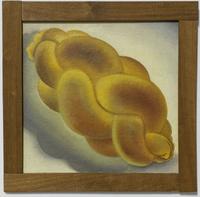
Bread
Vasyl Yermylov
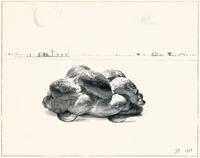
Car
Saul Steinberg
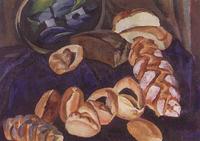
Bread on the blue
Pyotr Konchalovsky
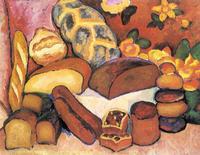
Still Life with Loaves of Bread
Ilya Mashkov
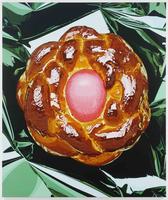
Bread with Egg
Jeff Koons
Moscow Food: Breads
Ilya Mashkov
Glass of Wine
Pierre-Auguste Renoir
Βrioche
Nikolaos Gyzis
Still life with red fish
Ilya Mashkov
Breakfast
Willem van Aelst
Easter Food
Constantin Stahi
Ferenczy Károly, Kalács És Kék Porcelán 1911
Karoly Ferenczy
Still Life / Breads
Nikolaos Gyzis
A brioche
Edouard Manet
Still Life
Giorgio Morandi
Breads and the tray
Pyotr Konchalovsky
Soviet breads
Ilya Mashkov
Bread
Mikhail Larionov