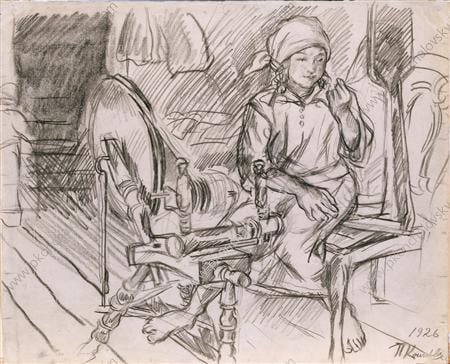
Spinner. Drawing for the painting 'spinner'.
Details
Expert analysis of Pyotr Konchalovsky’s Spinner. Drawing for the painting 'spinner'.
Style: Post-Impressionism · Genre: sketch and study
Artwork Analysis: "Spinner. Drawing for the painting 'spinner'" by Pyotr Konchalovsky
Style: Post-Impressionism
Genre: Sketch and study
Significance in Context
Pyotr Konchalovsky (1876–1956) was a leading figure in the Russian avant-garde, co-founding the influential Jack of Diamonds group, which championed Post-Impressionist principles—particularly the structural lessons of Paul Cézanne. This work, a preparatory drawing for the painting Spinner, holds significance for several reasons:
-
Reveals the Artist’s Process:
As a sketch and study, it offers a rare glimpse into Konchalovsky’s method of distilling a subject to its essential formal elements. The focus on a single figure—a spinner at work—demonstrates his interest in capturing both the physical rhythm of labor and the geometric simplification of the human form, a hallmark of his Post-Impressionist approach. -
Bridging Representation and Abstraction:
While still representational, the drawing emphasizes line, volume, and planar structure over anecdotal detail. This aligns with the Jack of Diamonds’ pursuit of a robust, “constructed” realism, influenced by Cézanne’s treatment of form as a series of interlocking planes. The spinner’s pose likely echoes the repetitive circular motion of her task, a motif that connects domestic labor to universal geometric order. -
Russian Post-Impressionism in Practice:
Unlike many Western European Post-Impressionists, Russian artists like Konchalovsky often fused Cézannian structure with native folk or everyday subjects. Spinner is a perfect example: the humble theme of a spinner—rooted in Russian rural tradition—is treated with the monumental simplicity of a still life, elevating the ordinary through rigorous formal discipline. -
Preparatory Role and Artistic Intent:
The existence of this drawing for a known painted work underscores Konchalovsky’s deliberate craftsmanship. It allows scholars to trace how he transferred his investigations of line and shadow into color and full-scale composition—a process central to the Post-Impressionist emphasis on the artist’s deliberate decisions over mere visual impression.
In summary, this sketch is not a minor artifact but a key document of Russian Post-Impressionism. It encapsulates how Konchalovsky merged Cézanne’s structural clarity with a distinctly Russian subject, while offering insight into the analytical groundwork behind his finished masterpieces.
Visually similar
20 works with related composition and palette
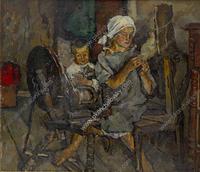
Spinner
Pyotr Konchalovsky
Woman Reeling Yarn
Vincent van Gogh
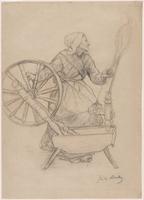
Woman at the spinning wheel
Jules Breton
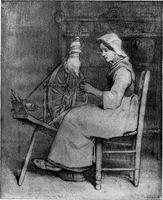
The spinner
Jean-Francois Millet
Bobbin Winder
Vincent van Gogh
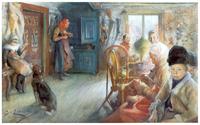
Peasant Interior in winter
Carl Larsson
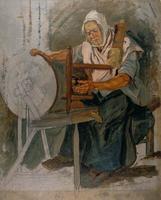
Old Spinner
George Harvey
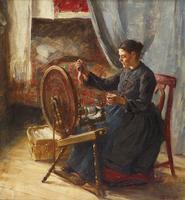
Spinnerskan
Elin Danielson-Gambogi
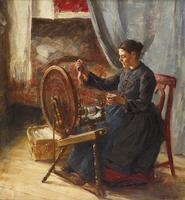
The spinner
Elin Danielson-Gambogi
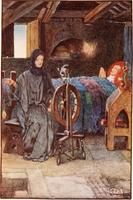
Some Little Bird Sang to Me Most Blithely
Eleanor Fortescue-Brickdale
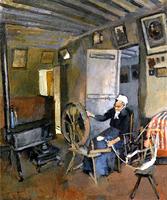
The Skein Winder From Picardy
Henri Matisse
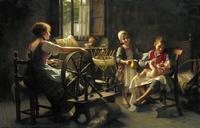
Family In An Interior
Giovanni Battista Torriglia
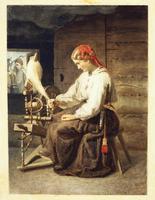
Ketraja
Johann Koler
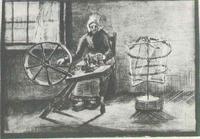
Woman Reeling Yarn
Vincent van Gogh
Tangles
Francis Day
Untitled
Fedir Krychevsky
Aged Spinner
George Harvey
In Grandmothers Time
Thomas Eakins
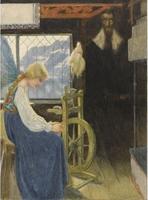
Senta and the Flying Dutchman
Heinrich Lefler
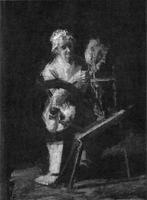
Sketch for In Grandmother's Time
Thomas Eakins