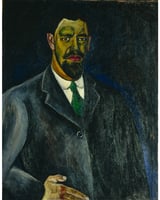
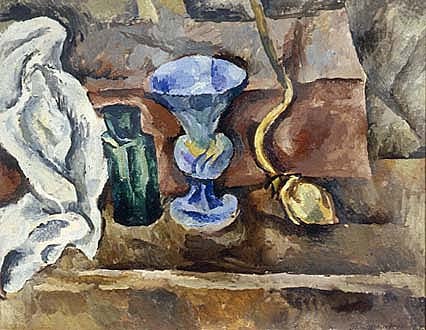
Expertenanalyse zu Pyotr Konchalovskys Still Life. Lotus.
Stil: Cubism · Genre: still life
Expert Analysis: "Still Life. Lotus." by Pyotr Konchalovsky
Pyotr Konchalovsky’s Still Life. Lotus. (c. 1910s) stands as a pivotal example of Russian Cubism’s distinct development, merging the analytical vocabulary of Western avant-garde movements with a uniquely Russian sensibility. As a leading member of the Jack of Diamonds group, Konchalovsky rejected the ethereal symbolism of earlier Russian art in favor of a robust, materialist exploration of form and color.
Significance within Cubism and Period
-
Synthesis of Cézanne and Cubism: Unlike the monochromatic, fragmentary Cubism of Picasso and Braque, Konchalovsky retained a strong Cézannesque emphasis on volumetric structure and vibrant, unmodulated color. In Still Life. Lotus., the flower’s petals and leaves are fractured into geometric facets, yet the composition retains a palpable sense of weight and organic rhythm. This approach—often called Cézannian Cubism or Synthetic Cubism with a Russian accent—bridged Post-Impressionism and High Cubism.
-
Folkloric and Eastern Influences: The choice of the lotus—a symbol of eastern spirituality and exoticism—is significant. Konchalovsky often incorporated motifs from Russian folk art, icon painting, and even Oriental ceramics into his still lifes. Here, the lotus’s stylized, overlapping planes evoke the flattened perspective of Russian icons, while the bold contours and saturated reds, greens, and ochres recall traditional lubok prints. This infusion of native decorative traditions gave Russian Cubism a chromatic and symbolic vitality absent in its French counterpart.
-
Materiality and Tactility: Where European Cubism tended toward abstraction, Konchalovsky’s still lifes remain anchored in the tangible world. The thick impasto and energetic brushwork in Still Life. Lotus. emphasize the physical presence of the flower and the tabletop, celebrating the objecthood of the subject. This reflects the Jack of Diamonds’ manifesto: to “[take] the object as the starting point for painting, not as an illustration.”
Conclusion: Still Life. Lotus. exemplifies how Konchalovsky and his peers transformed Cubism into a vehicle for Russian modernist identity—simultaneously avant-garde and deeply rooted in vernacular artistic traditions. Its bold color, decorative structure, and architectural handling of natural forms mark a crucial contribution to the international Cubist movement, proving that the style could be both analytical and expressive.
Visuell ähnlich
20 Werke mit ähnlicher Komposition und Farbpalette
Still life
Pyotr Konchalovsky
Grande natura morta con la caffettiera
Giorgio Morandi
Still life
Andre Derain
Still life with jug
Pyotr Konchalovsky
Berény Róbert , Csendélet Kancsóval És Gyümölcsel, 1911
Berény Róbert
Blue Pitcher
Henri Matisse
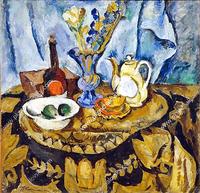
Still Life with a Coffeepot
Pyotr Konchalovsky
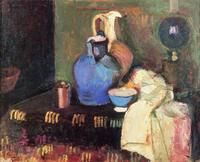
The Blue Jug
Henri Matisse
Berény Róbert , Kancsós Csendélet 1901
Berény Róbert
Lemon, walnuts and pot with tobacco
Georges Braque
Still Life. The green glass.
Pyotr Konchalovsky
Still Life
Giorgio Morandi
Still Life with Green Pot and Pewter Jug
Paul Cezanne
Still life on a white tablecloth
Robert Falk
Still Life
Max Weber
Still LIfe with Fish and Pitcher
Chaim Soutine
Still Life. Candlestick and pear.
Pyotr Konchalovsky
Natiurmortas Su Geltona Vaza
Vytautas Kairiukstis
Dessert
Paul Cezanne
Natura Morta
Giorgio Morandi