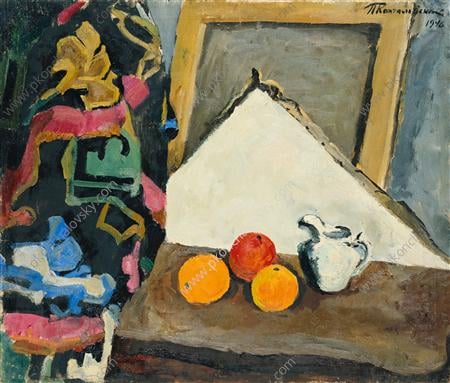
Still Life. Oranges, stretcher and carpet.
Ayrıntılar
Pyotr Konchalovsky sanatçısının Still Life. Oranges, stretcher and carpet. eseri hakkında uzman analizi
Tarz: Fauvism · Tür: still life
Pyotr Konchalovsky’s “Still Life. Oranges, Stretcher and Carpet” is a quintessential example of Russian Fauvism, particularly from the artist’s association with the avant-garde group Jack of Diamonds (1910–1916). While Fauvism originated in France with artists like Matisse and Derain, Konchalovsky infused the movement’s signature bold, non-naturalistic color and expressive brushwork with a distinctly Russian sensibility—drawing on folk art, icon painting, and the decorative traditions of the East.
What makes this work significant within Fauvism and its period:
-
Vibrant color orchestration: The oranges are rendered in fiery oranges and yellows against a deep, resonant carpet pattern. Konchalovsky treats color not as descriptive but as emotional and structural—a key Fauvist principle. The contrast between the fruit’s saturated citrus tones and the richly patterned textile creates a dynamic tension that energizes the composition.
-
The inclusion of the “stretcher”: The canvas stretcher (a wooden frame used to mount painting supports) is a deliberate, almost self-referential element. By placing it among the oranges and carpet, Konchalovsky collapses the boundary between art object and everyday object, hinting at the Fauvist desire to flatten space and foreground the materiality of paint. It also subtly comments on the artist’s process—a meta-pictorial gesture common to early modernism.
-
Intersection of Western and Russian traditions: Unlike French Fauvist still lifes that often emphasized bourgeois leisure (tables, vases, fruit bowls), Konchalovsky’s carpet introduces a decorative, almost folkloric pattern. This aligns with the Russian avant-garde’s interest in lubok (popular prints) and traditional crafts, making the work a bridge between Matissean color and Slavic ornament.
-
Rejection of illusionistic depth: The flat, compressed space—with the carpet rising vertically and the fruit crowding the foreground—reflects the Fauvist abandonment of Renaissance perspective. The stretcher’s grid-like structure further reinforces the picture plane, reminding the viewer that this is paint on canvas, not a window onto reality.
In sum, the painting is significant for radicalizing Fauvism in a Russian context, merging Western color theory with native decorative aesthetics, and for its early modernist self-awareness—using the stretcher as a symbol of the artist’s constructed reality. It stands as a vibrant, confident expression of the early 20th-century urge to reinvent visual language.
Görsel olarak benzer
İlişkili kompozisyon ve renk paletine sahip 20 eser
Still Life on Table with a Picture
Kmetty János
Berény Róbert , Kancsós Csendélet 1901
Berény Róbert
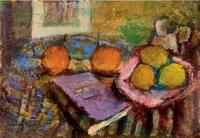
Modok Mária, Csendélet Gyümölcsel
Modok Mária
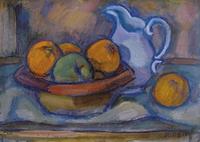
Still Life with Apples and Jug
Kmetty János
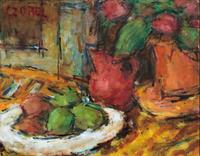
Bela Adalbert Czobel Still Life Wit Flowers and
Bela Czobel
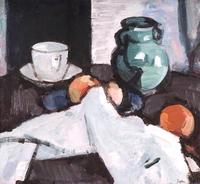
Still Life with Bowl of Fruit, Jug, Cup and Saucer
Samuel Peploe
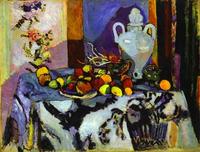
Blue Still Life
Henri Matisse
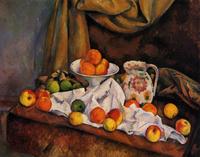
Fruit Bowl, Pitcher and Fruit
Paul Cezanne
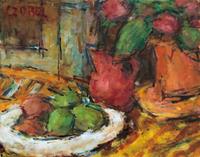
Czobel Still Life Gyümölcsökkel
Bela Czobel
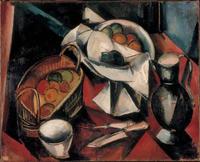
Still Life with Knife
Maurice de Vlaminck
Kmetty Still Life with Self Portrait
Kmetty János
Bela Czobel, Nature Morte 1963 Pompidou
Bela Czobel
Bela Czobel, Nature Morte 1963 Pompidou
Bela Czobel
Apples and Oranges
Paul Cezanne
Still Life with Apples and Pears
Kmetty János
Still life with jug
Paul Cezanne
Still Life Post, Bottle, Cup and Fruit
Paul Cezanne
Still Life With Pipe and Books
Adam Baltatu
Fruit and Jug on a Table
Paul Cezanne
Still Life with Pomegranate and Pears
Paul Cezanne