Analisi esperta di View from Dekkersduin di Johan Hendrik Weissenbruch
Stile: Realism · Genere: landscape
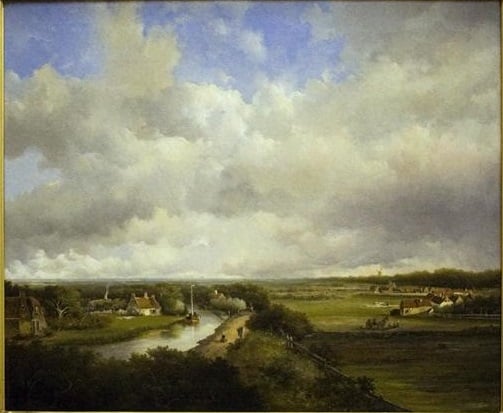
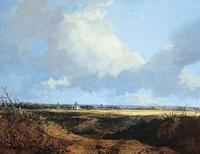
As an expert art historian analyzing View from Dekkersduin by Johan Hendrik Weissenbruch, the work’s significance within the Realist movement and the landscape genre hinges on its commitment to truthful, unidealized observation of the natural world.
Given that the artwork is classified as Realism, it aligns with the mid-19th-century reaction against Romanticism’s dramatic, invented vistas. Realist landscape painters sought to record the actual appearance of a specific place at a specific moment, often focusing on familiar, humble, or even mundane terrain rather than picturesque or heroic scenery. The title View from Dekkersduin immediately grounds the composition in a precise location (a dune near Scheveningen, Netherlands), signaling the artist’s dedication to a specific topographical truth.
As a landscape, the painting engages with a long Dutch tradition that prized atmospheric effects and subtle tonal harmonies—yet the Realist lens transforms this tradition. Where earlier Dutch landscapists might have emphasized compositional grandeur or moral allegory, Weissenbruch’s work is significant for its directness: the unembellished recording of light, air, and the expansive, often gray Dutch skies. The viewer is not offered a heroic narrative but rather the sensory experience of a particular place—the shifting clouds, the flat horizon, the quiet dunes. This aligns with Realism’s core goal of depicting “ordinary” nature with the same seriousness once reserved for history painting.
The artwork’s significance thus lies in its demonstration of how Realism elevated the landscape genre by demanding absolute fidelity to the artist’s immediate visual perception. View from Dekkersduin becomes a testament to the idea that a modest, unremarkable stretch of Dutch coast—when observed with rigorous honesty and refined technique—can achieve a profound, quiet monumentality. In this, Weissenbruch’s work stands as a prime example of how Realism reshaped landscape painting from a backdrop for human stories into a subject worthy of its own, full artistic stature.
Museum / Gallery
Visivamente simili
20 opere con composizione e palette affini
East Anglian River Landscape with Windmills and Church
Joseph Stannard
Pastoral Landscape with Cattle
Heinrich Deiters
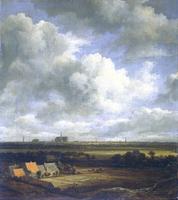
View of Haarlem with bleaching fields in the foreground
Jacob van Ruisdael
The Avon from Bideford
Edward R. Taylor
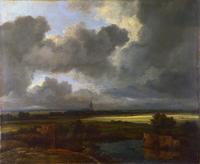
Landscape with Ruined Castle and Church
Jacob van Ruisdael
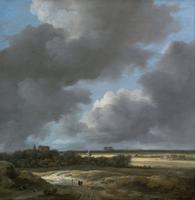
View of Alkmaar
Jacob van Ruisdael
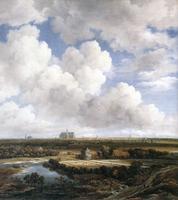
View of Haarlem with Bleaching Grounds
Jacob van Ruisdael
View of Naarden
Jacob van Ruisdael
The pond near the road
Theodore Rousseau
A summery day in the countryside
Johannes Joseph Destrée
A Bit of Sussex
James Webb
Dune Landscape near Haarlem
Jacob van Ruisdael
Bavarian Landscape
Albert Bierstadt
Landscape. Bank of the Volga
Aleksey Savrasov
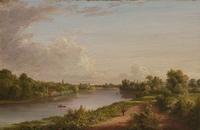
View of the Thames
Thomas Cole
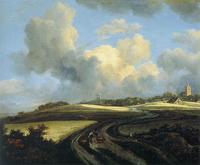
Road through Corn Fields near the Zuider Zee
Jacob van Ruisdael
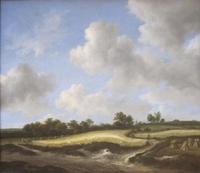
Landscape with a Wheatfield
Jacob van Ruisdael
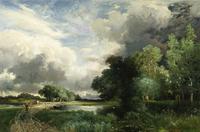
Approaching Storm Clouds
Thomas Moran
St Benet's Abbey, Norfolk
John Crome
Dune Landscape with a Rabbit Hunt
Jacob van Ruisdael