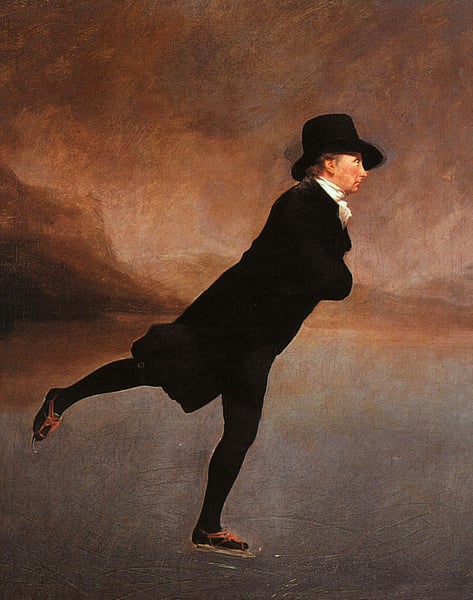
The Skating Minister (The Reverend Robert Walker Skating on Duddingston Loch)
Details
Description
Style: Romanticism · Genre: portrait
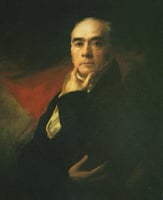
"The Skating Minister" was practically unknown until about 1949; today, however, it is one of Scotland's best known paintings. It is considered an icon of Scottish culture, painted during one of the most remarkable periods in the country's history, the Scottish Enlightenment. The clergyman portrayed in this painting is the Reverend Robert Walker. He was a Church of Scotland minister who was born on 30 April 1755 in Monkton, Ayrshire. As a child, Walker's father had been minister of the Scots Kirk in Rotterdam, thus the young Robert almost certainly learnt to skate on the frozen canals of the Netherlands. He was minister of the Canongate Kirk as well as being a member of the Edinburgh Skating Club, the first figure skating club formed anywhere in the world. The club met on Duddingston Loch as shown in the painting, or on Lochend loch to its northeast between Edinburgh and Leith, when these lochs were suitably frozen. In March 2005, a curator from the Scottish National Portrait Gallery suggested that the painting was by the French artist Henri-Pierre Danloux, rather than Sir Henry Raeburn. Once this information had been brought to the attention of the Gallery, the label on the painting was altered to read "Recent research has suggested that the picture was actually painted....by Adrian Bordeaux." Since this time, many people have debated the idea of this. It has been argued that Danloux was in Edinburgh during the 1790s, which happens to be the time period when The Skating Minister was created. Supposedly the canvas and scale of the painting appears to be that of a French painter, although Raeburn critics argue otherwise. Despite continuing controversy about its attribution, The Skating Minister was sent to New York City in 2005 to be exhibited in Christie's for Tartan Day, an important Scottish celebration. James Holloway, director of the Scottish National Portrait Gallery, told The Scotsman newspaper that "my gut reaction is that it is by Raeburn." The newspaper reported that "it is understood that Sir Timothy Clifford, director-general of the National Galleries of Scotland, now accepts the painting is a Raeburn."
Museum / Gallery
Visually similar
20 works with related composition and palette
Count Fernand Nunez VII
Francisco Goya
Portrait of A.I. Baryshnikov
Vasily Tropinin
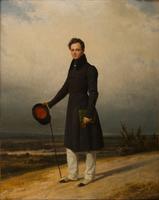
Portrait of Claude-Marie Dubufe against a landscape background
Pierre Duval Le Camus
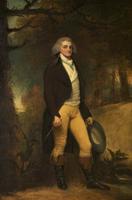
George Harry, Lord Grey of Groby (1765–1845), Later 6th Earl of Stamford
George Romney
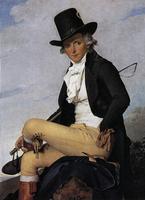
Portrait of Pierre Seriziat the artist's brother-in-law
Jacques-Louis David
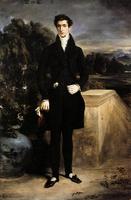
Portrait of Baron Schwiter
Eugene Delacroix
Beggar Boy
Etienne Jeaurat
Self-portrait
Ralph Earl
Robert Jenkinson, 2nd Earl of Liverpool
Thomas Lawrence
Louis-Philippe, Duke of Orléans, in a Swiss landscape
Horace Vernet
Gilbert McHutchin
William Williams
Portrait of An Unknown Man in a Landscape
Pierre Duval Le Camus
Portrait of a young boy in a brown coat and breeches, holding a skipping rope before a landscape
Lemuel Francis Abbott
Warren Hastings (1732–1818), Governor General of Fort William, Bengal (1774–1785)
George Romney
David Garrick
Thomas Gainsborough
Portrait of Don Francisco de Borja Tellez Giron
Francisco Goya
Patrick Heatly
Johann Zoffany
Portrait of a Young Man
Julius Caesar Ibbetson
George Hay Dawkins-Pennant (1764–1840)
John Jackson
Edward Becher Leacroft
Joseph Wright