Philip Guston sanatçısının Green Rug eseri hakkında uzman analizi
Tarz: Neo-Expressionism · Tür: interior
Expert Analysis of Philip Guston’s Green Rug
Context and Significance
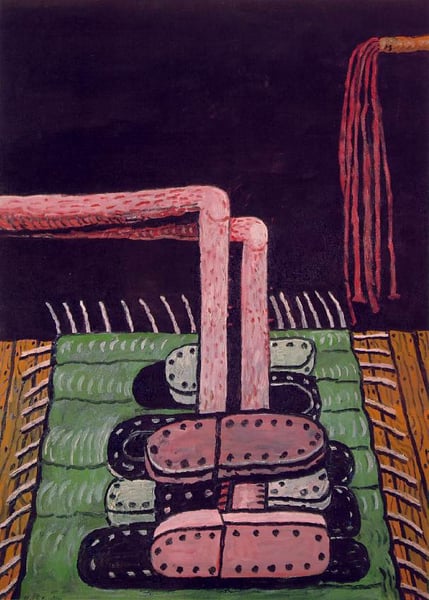
Philip Guston’s Green Rug (an interior genre painting from the Neo-Expressionist period) marks a decisive turning point in the artist’s career and in the broader trajectory of late 20th-century painting. After decades as a celebrated Abstract Expressionist, Guston shocked the art world in the late 1960s and 1970s by abandoning pure abstraction for a deliberately crude, cartoon-like figuration. Green Rug exemplifies this radical shift, situating itself squarely within the Neo-Expressionist movement’s embrace of raw, subjective emotion, personal iconography, and a rejection of both Minimalism and Conceptualism.
What Makes Green Rug Significant
-
Reclamation of the Everyday as Symbol – The painting’s subject—a domestic interior featuring a green rug—appears banal, yet Guston transforms it into a site of psychological tension. The rug is not decorative; it becomes a charged stage for the artist’s recurring motifs of isolation, anxiety, and the mundane grotesque. This aligns with Neo-Expressionism’s interest in the personal and the autobiographical, often filtered through a rough, unpolished aesthetic.
-
Formal Antidote to Abstraction – Guston’s treatment of the rug is deliberately anti-compositional: heavy, unblended brushstrokes; a muddy, off-putting green; and a flattened, claustrophobic space. This aggressive handling rejects the lyrical, refined marks of his abstract period. Instead, it offers a Neo-Expressionist emphasis on visceral immediacy and emotional directness, akin to contemporaries like Julian Schnabel or Georg Baselitz, but with a distinctly American, even comic, darkness.
-
Interior as Psychological Territory – The genre of “interior” is here stripped of coziness. The green rug anchors a space that feels both empty and ominous, suggesting the artist’s lifelong preoccupation with the “studio” as a site of struggle. In the context of Neo-Expressionism, this returns painting to a narrative function—but one riddled with ambiguity. The rug is simultaneously a literal object and a metaphor for the artist’s own unstable ground.
-
Legacy of Transgression – When Guston unveiled his figurative works, they were dismissed by critics who saw them as a betrayal of High Modernist abstraction. Green Rug now stands as a foundational work for Neo-Expressionism, proving that painting could re-engage with the messiness of the real world without sacrificing formal power. Its significance lies in its audacity: to paint a green rug with such deliberate awkwardness is to assert that meaning can emerge from the most prosaic subject when treated with raw conviction.
In sum, Green Rug is not merely an interior scene; it is a manifesto. It declares that painting after Abstract Expressionism can be figurative, awkward, and deeply personal—qualities that became the hallmark of Neo-Expressionism and that continue to influence contemporary art’s embrace of the autobiographical and the unresolved.
Görsel olarak benzer
İlişkili kompozisyon ve renk paletine sahip 20 eser
Room
Philip Guston
Ancient Wall
Philip Guston
The Street
Philip Guston
The Pit
Philip Guston
Two fat feet
Philip Guston
Painter's Forms No. 2
Philip Guston
Inhospitable Feast
Conroy Maddox
Hexagram 41
Oleksandr Aksinin
Daydreams
Philip Guston
Composition I
Gene Davis
Model. Study
Franciska Clausen
La tranche de pastèque
Corneille
944 Blue Blues
Friedensreich Hundertwasser
Erinnerungen I
Antoni Tapies
En la Trayectoria del Tiempo
Ramon Oviedo
Moon
Philip Guston
The Mistress
Konrad Klapheck
Back View
Philip Guston
Cubist Pipe Lines
Le Corbusier
Granny Carolina
Carol Rama