Gerhard Richter sanatçısının Ema eseri hakkında uzman analizi
Tarz: New European Painting · Tür: figurative
Analysis of "Ema" by Gerhard Richter
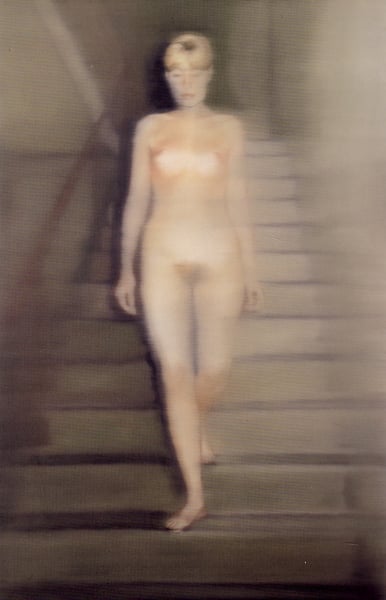
Gerhard Richter’s "Ema" (1966) stands as a seminal work within the context of New European Painting, a movement that re-engaged with figuration and painterly technique in the wake of postwar abstraction. Though the work is figurative—depicting the artist’s wife, Ema, in a domestic setting—its significance lies in how Richter simultaneously undermines and reasserts the act of painting.
The painting is executed with Richter’s signature blur (Verschwommenheit), a technique derived from his photo-based practice. He would project a photographic image onto canvas and then drag a dry brush across the still-wet paint, smearing details into a soft, out-of-focus haze. This creates a perceptual tension: the viewer recognizes a recognizable scene (a woman nude, turning away) but is denied the clarity of a photograph or a traditional portrait.
What makes "Ema" significant is its dual interrogation of representation and memory. The blur does not erase the figure; instead, it suggests the ephemerality of perception, the fragility of recollection, and the gap between photographic truth and artistic interpretation. Richter described his blur as a way to make painting “more honest”—acknowledging that any image is always already mediated. In this, "Ema" becomes a paradigmatic New European Painting: it reclaims figuration from both photorealism (which would seek exact replication) and from abstraction (which would abandon the figure entirely), using painterly means to comment on the nature of seeing itself.
Furthermore, the work balances intimacy and distance. The subject is personal (his wife), yet the blur depersonalizes her, elevating the image from a private portrait to a universal meditation on how we look at photographs, at paintings, and at the people we love. "Ema" thus embodies Richter’s larger project of making paintings that “function like photographs” while remaining unmistakably handmade—a paradox that defines his influence on contemporary figurative painting in Europe and beyond.
Museum / Gallery
Görsel olarak benzer
İlişkili kompozisyon ve renk paletine sahip 20 eser
Study of a Female Nude
Salvador Dali
Petit Nu
Jean Paul Lemieux
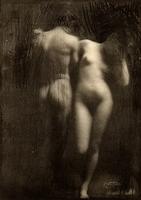
Adam and Eve
Frank Eugene
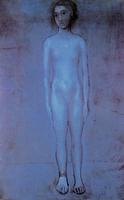
Standing young nude
Pablo Picasso
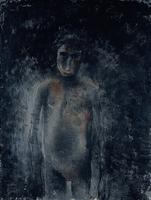
Nu noir
Jean Fautrier
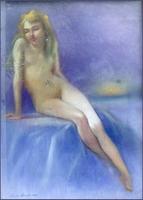
Nude sitting
Nicolae Vermont
Woman with child (Mother and son)
Alberto Sughi
Nude Woman Curled Up
Lucien Levy-Dhurmer
Sea triangle
Oleg Holosiy
Elsa
Carlos Almaraz
Untitled
Zdzislaw Beksinski
Aktstudie
Fernand Khnopff
Mueller
Tony Scherman
Untitled
Zdzislaw Beksinski
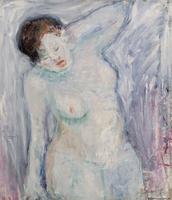
Alaston
Sallinen Tyko
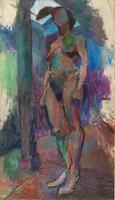
Faith, the Model
Henri Matisse
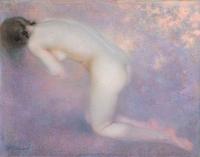
Ariette
Lucien Levy-Dhurmer
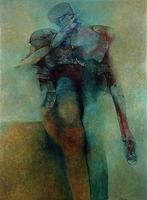
Untitled
Zdzislaw Beksinski
Circus Girl
Helene Schjerfbeck
Petit nu noir
Jean Fautrier