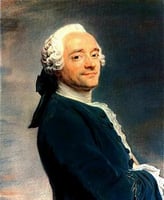
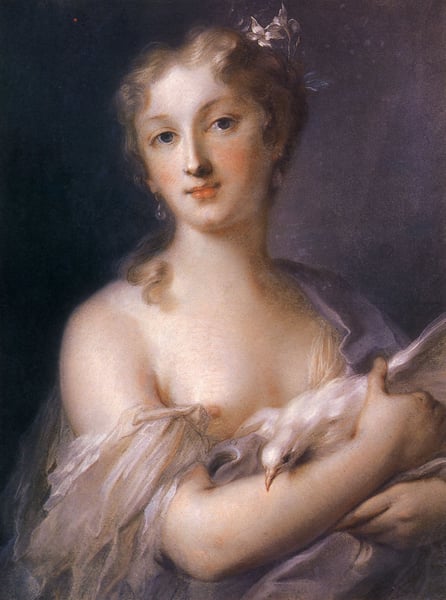
Expert analysis of Maurice Quentin de La Tour’s Nymph followed by Apollo
Style: Rococo · Genre: portrait
Expert Analysis: "Nymph followed by Apollo" by Maurice Quentin de La Tour
Maurice Quentin de La Tour is celebrated as the undisputed master of pastel portraiture in 18th-century France, and Nymph followed by Apollo embodies the quintessential Rococo blend of elegance, playful sensuality, and artifice. Despite the mythological framing suggested by the title, the work is firmly a portrait—a specialty in which La Tour excelled, particularly in capturing the psychological presence and social grace of his sitters.
Significance within Rococo and La Tour’s Oeuvre
-
Technical Mastery of Pastel
La Tour’s pastel technique was revolutionary. In this work, the soft, velvety texture of the medium creates an almost ethereal luminosity, perfectly suited to the Rococo preference for delicate, airy compositions. The shimmering skin tones, the diaphanous treatment of drapery, and the subtle gradations of light demonstrate his ability to render flesh with a lifelike warmth that rivals oil painting—elevating pastel from a secondary medium to a primary vehicle for high-art portraiture. -
Rococo Aesthetics: Playful Mythology Meets Portrait
While the genre is portraiture, the title alludes to a mythological scene (the nymph pursued by the sun god Apollo). This reflects the Rococo fascination with blending reality and fantasy: the sitter is likely a contemporary aristocratic woman or actress posed as a nymph, allowing La Tour to indulge in decorative, pastoral motifs while maintaining the intimate scrutiny of a portrait. The implied narrative—Apollo’s desire following the fleeing nymph—adds a layer of flirtatious wit, a hallmark of Rococo gallantry. -
Psychological Insight and Social Artifice
La Tour’s portraits are renowned for capturing not just likeness but the sitter’s character. Here, the nymph’s sidelong glance and half-smile suggest a coquettish awareness of the viewer (or Apollo), blending innocence with cunning. Yet the polished elegance of the pose and the refined pastel hues (soft pinks, pale blues, creamy whites) also reveal the sitter’s social performance—a key Rococo concern with the theater of courtly life. -
Significance as a Rococo Portrait
Unlike earlier Baroque portraits that emphasized grandeur and power, Rococo portraits like this one prioritize charm, intimacy, and decorative beauty. La Tour’s choice of a mythological disguise allows the sitter to inhabit a timeless ideal of feminine allure, while the artist’s virtuoso handling of light and texture reaffirms the portrait as a vehicle for both aesthetic pleasure and personal flattery.
Conclusion
Nymph followed by Apollo is significant as a masterful example of La Tour’s pastel portraiture, showcasing the Rococo’s love for elegant artifice, playful mythology, and the celebration of refined sensuality. It stands as a testament to the artist’s ability to merge the specific persona of a sitter with the universal allure of a mythological figure, all rendered with the luminous, tactile delicacy that defines Rococo art at its peak.
Museum / Gallery
Visually similar
20 works with related composition and palette
Nymph followed by Apollo
Maurice Quentin de La Tour
Nymph followed by Apollo holding a laurel wreath
Maurice Quentin de La Tour
Autumn
Rosalba Carriera
Summer
Rosalba Carriera
The Singer Faustina Bordoni with a Musical Score
Rosalba Carriera
Girl with a Dove
Antoine Pesne
Flora
Rosalba Carriera
Personification of Spring
Rosalba Carriera
Spring
Rosalba Carriera
Young Woman with Flowers in Her Hair wrongly called Portrait of Madame Boucher
Francois Boucher
Spring
Adolphe Piot
Countess Ekaterina Riboper
Vladimir Borovikovsky
Vénus
Gortzius Geldorp
Portrait of María del Pilar Ana de Silva-Bazán y Sarmiento
Anton Raphael Mengs
Portrait of E. N. Arsenyeva
Vladimir Borovikovsky
Kitty Fisher (d.1767)
Nathaniel Hone the Elder
Winter
Rosalba Carriera
Portrait of a Young Girl
Rosalba Carriera
Lady Hamilton as Circe
George Romney
A Beautiful Lady with Red Hair
Albert Lynch