
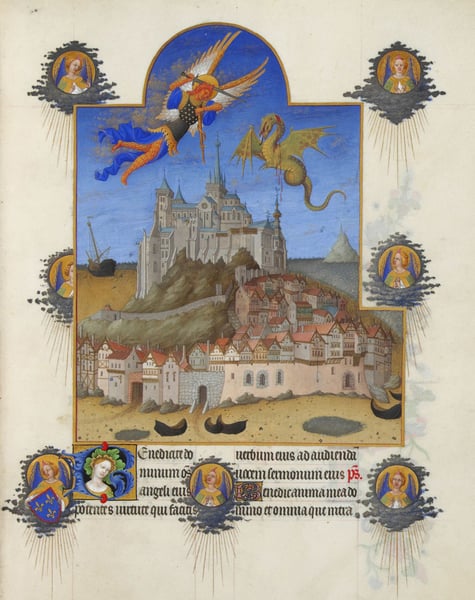
Analisi esperta di The Mass of Saint Michael di Limbourg brothers
Stile: International Gothic · Genere: illustration
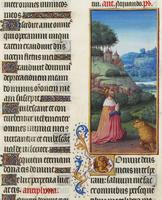
"The Mass of Saint Michael" by the Limbourg brothers is a quintessential example of International Gothic manuscript illumination, created around 1410–1416 for the Très Riches Heures du Duc de Berry. This work is significant not only as a masterpiece of the style but also for its pioneering fusion of religious narrative with meticulous naturalism and decorative splendor.
Stylistic Significance within International Gothic: The painting exemplifies the hallmark traits of International Gothic: elongated, graceful figures with delicate, swaying postures; rich, jewel-like colors (especially deep blues, reds, and gold); and a profusion of intricate, ornamental detail. The composition balances a sacred scene with a heightened sense of earthly elegance—the angels and Saint Michael are rendered with refined, almost courtly grace, their robes cascading in soft, rhythmic folds. This reflects the period’s love of aristocratic sophistication, even in religious imagery.
Innovative Narrative and Atmospheric Depth: What sets this work apart is its atmospheric sensitivity. The Limbourg brothers infuse the scene with a subtle unity of light and space: the golden halos and celestial rays contrast with a softly lit, architectural interior that hints at early naturalistic perspective. The careful rendering of liturgical objects—the altar, the chalice, the book—grounds the miraculous mass in a tangible, believable world. This blend of the sacred and the mundane was revolutionary, elevating manuscript illumination from mere decoration to a vehicle for emotional and spatial depth.
Technical Mastery and Cultural Context: The use of burnished gold leaf, lapis lazuli, and vermilion creates a luminous, almost otherworldly effect, typical of the Limbourgs’ technique. Such luxury materials signaled the patron’s (the Duke of Berry’s) immense wealth and piety. The scene also reflects the era’s fascination with angelic hierarchies and the cult of Saint Michael as a warrior-saint and protector—a theme resonating with the turbulent Hundred Years’ War context.
In summary, “The Mass of Saint Michael” is significant for its perfect synthesis of International Gothic’s elegance, emerging naturalism, and devotional intensity. It stands as a testament to the Limbourg brothers’ role as bridge-builders between medieval manuscript tradition and the dawning Renaissance sensitivity to space, light, and human emotion.
Visivamente simili
20 opere con composizione e palette affini
The Temptation of Christ
Limbourg brothers
The Death of Bertrand du Geusclin (c.1320-80) at Chateauneuf-de-Randon
Jean Fouquet
Calendar: March (Peasants at Work on a Feudal Estate)
Limbourg brothers
The Annunciation to the Shepherds
Limbourg brothers
Coronation of Louis VI
Jean Fouquet
The Procession of Saint Gregory
Limbourg brothers
Conversation Between St. Gontran and St. Childebert II
Jean Fouquet
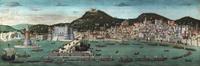
Tavola Strozzi
Francesco Pagano
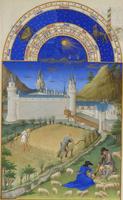
Calendar: July (Harvesting and Sheep Shearing)
Limbourg brothers
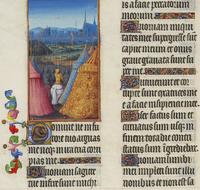
Psalm XXXVII
Limbourg brothers
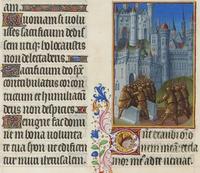
An Attack on a City
Limbourg brothers
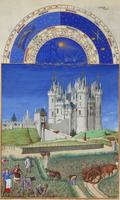
Calendar: September (Grape Picking)
Limbourg brothers
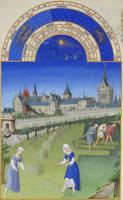
Calendar: June (Haymaking)
Limbourg brothers
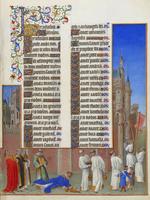
The Procession of Saint Gregory
Limbourg brothers
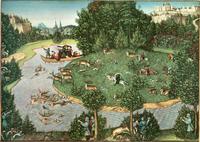
Stag Hunt of Elector Friedrich III the Wise
Lucas Cranach the Elder
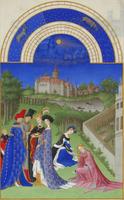
Calendar: April (Courtly Figures in the Castle Grounds)
Limbourg brothers
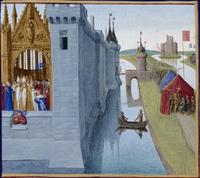
Coronation of Louis VI
Jean Fouquet
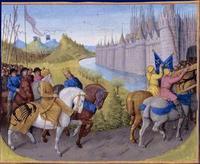
Crusaders Arrived in Constantinople. Battle Between the French and Turks in 1147 and 1148
Jean Fouquet
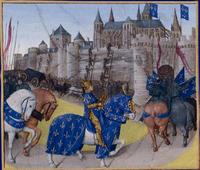
Taken in Tours in 1189
Jean Fouquet
Psalm VII
Limbourg brothers