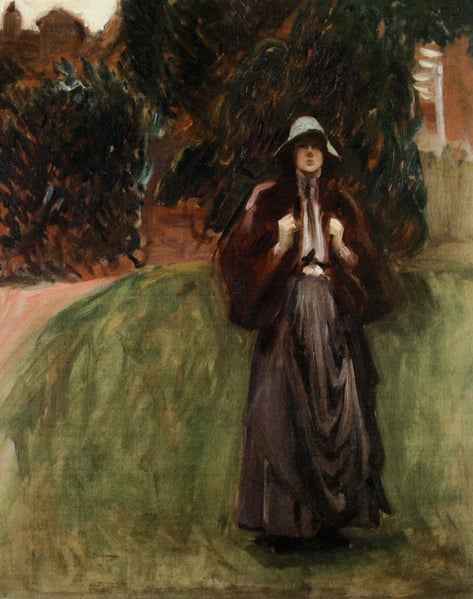
Portrait of Miss Clementine Anstruther-Thomson
Analisi esperta di Portrait of Miss Clementine Anstruther-Thomson di John Singer Sargent
Stile: Impressionism · Genere: portrait
Expert Analysis: Portrait of Miss Clementine Anstruther-Thomson by John Singer Sargent
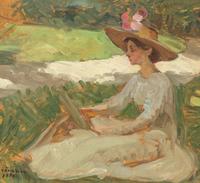
John Singer Sargent’s Portrait of Miss Clementine Anstruther-Thomson is a striking example of how the artist synthesized the spontaneity of Impressionism with the psychological depth of high-society portraiture. Although Sargent is often associated with Edwardian elegance and bravura technique, this work firmly aligns with Impressionist concerns: the play of natural light, loose yet deliberate brushwork, and an emphasis on capturing a fleeting moment of character rather than a rigid, formal likeness.
Significance within Impressionism
The painting showcases Sargent’s mastery of plein air luminosity even in an interior or garden setting. The sitter’s face is rendered with quick, visible touches of pigment—particularly around the eyes and mouth—where highlights and shadows are built not from smooth blending but from adjacent strokes of pure color. This technique, derived from Monet and Renoir, allows the portrait to feel alive and immediate. The background, likely a verdant landscape or sun-dappled wall, is treated with similarly impressionistic dashes that dissolve into atmosphere, preventing the figure from becoming isolated in a static space. Instead, the sitter breathes within her environment.
Portrait Genre Innovation
Clementine Anstruther-Thomson (1857–1921) was herself an art theorist and writer on aesthetic psychology, making her a fitting subject for an artist who believed in capturing the inner vitality of his sitters. Sargent’s portrait avoids the stiff formality of earlier Victorian portraiture; her pose is natural, her expression contemplative yet direct. The slight tilt of her head and the relaxed arrangement of her hands suggest an intellectual ease that aligns with her reputation as a perceptive critic. Sargent uses Impressionist techniques not merely for decorative effect but to convey her modernity and independence—a woman of intellect in a changing world.
Artistic Legacy
This work is significant because it demonstrates that Impressionism, often associated with landscapes and everyday scenes, could be successfully applied to the psychologically nuanced portrait. Sargent’s fusion of dappled light, spirited brushwork, and penetrating character study bridges the gap between the academic portrait tradition and avant-garde experimentation. In doing so, he elevates a conventional genre into a vibrant meditation on personality and perception, securing the painting’s place as an important example of late-nineteenth-century portraiture’s evolution.
Museum / Gallery
Visivamente simili
20 opere con composizione e palette affini
Clementina Austruther Thompson
John Singer Sargent
A Volta do Passeio
Columbano Bordalo Pinheiro
The Overseer on the Plantation
Eastman Johnson

Madame Edouard Pailleron (study)
John Singer Sargent
Z Parasolką Po Parku - Jesień
Teodor Axentowicz
Maternal joys
Cristiano Banti
Two female figures
Ivan Shishkin
A Stroll in the Park
William James Glackens
Beneath the Lilac at Maurecourt
Berthe Morisot
Young Lady Seated on a Bench
Berthe Morisot
The landlady
Silvestro Lega
Young Woman and Child, Avenue du Bois
Berthe Morisot
The engaged couple
Silvestro Lega
Croquet
Edouard Manet
Susan Seated Outdoors Wearing a Purple Hat
Mary Cassatt
Young woman in the garden
Edouard Manet
Woman on a Hill
Eastman Johnson
Avenue with figures
Vittorio Corcos
Autumn
Winslow Homer
Reading in the Garden
Ipolit Strambu